


Synapsis Pansophia:
The Universal Wisdom Compendium:
Pansophia represents the Total Field. In an era defined by the Archipelago of Incommensurability, where different fields of knowledge act as isolated and mutually deaf islands, this path is the bridge of Consilience. It is rooted in the conviction that the Logos is a unified, entangled field of meaning. Here, we dissolve the false binaries between Eastern holism and Western empiricism, between the mystical Eye of the Heart, the Path of reason, and the neurobiological pulse. This is where we architect the Nous, the shared dream of a home in a migratory world by synthesizing the world's perennial traditions into a unified field of wisdom.
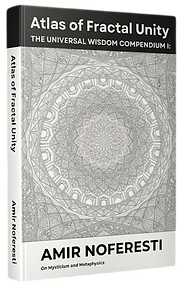
Atlas of fractal unity:
On mysticism and metaphysics: A high-bandwidth synthesis of the world's perennial traditions, this compendium acts as a Semantic Bridge between Eastern holism and Western inquiry. It explores the non-local entanglement of mystical experience and metaphysical structure, revealing a unified field of wisdom that transcends linguistic and cultural boundaries. It is an archive of resonance, designed to facilitate the transition from fragmented knowledge to a participatory realization of the Whole.
The Axis of Self and Other
On Mythology and Meaning: An excavation of the archetypal structures that govern the intersubjective field. This work analyzes how mythological grammars provide the Axis upon which our perception of the Other is balanced. By deconstructing the narrative arcs of identity and alterity, it reveals the shared intentionality that underlies our collective stories. It is a guide for the poly-ontological agent seeking to bridge the gap between individual myth and the shared Intersubjective Now.


The Science of Becoming
On Knowledge and Consciousness: The static machine model of the mind, this work presents an enactivist epistemology where knowing is a participatory act of creation. It bridges the gap between the hard drive of information and the pulse of lived consciousness, mapping the process of becoming as a continuous feedback loop between the observer and the field. It is a manifesto for the Nu-Cognitive Revolution, where truth is not a static destination but a process of systemic resurrection.
Next in this series to be published:
The Self in a Mirror: Metacognitions & Transpositionalism
Axis of Self and Better Self: Theology and Divinity
Ethos of Self and Other: Ethics & Understanding
Synapsis Via Necessitatis:
The Path of the Must
The Gravitational Pull of the Real, named after the Greek Ananke (Necessity), this path explores the truths that are not merely chosen by the ego, but demanded by existence. Via Necessitatis is the encounter with the Absolute. It is the recognition that certain insights are Musts, ontological imperatives that sustain being against the threat of nihilism. This path guides the reader through the Aporia (the shipwreck of linear logic) to show that the most profound disclosures of truth often happen within the Holy Wound of paradox and the quiet hum of the ordinary.
The Ousia: An Ontological must
The Phenomenology of the Ordinary Integrating the technical rigors of systemic cybernetics with the embodied intimacy of phenomenological inquiry, this work reveals the mundane architecture of daily life as a saturated site of metaphysical revelation. It is an invitation to dwell within the quiet hum of existence, the Profanum Ordinarium, where a coffee cup or a worn handrail becomes a disclosure of Being. It argues that the cure for contemporary nihilism lies not in escaping the everyday, but in an attentive, disciplined dwelling within its hidden light.


The Numinous: A Philosophical must
The Theology of the Wound: A manifesto for re-enchanting reality by recovering the storm of paradox at the heart of existence. This work defines philosophy as a practice of perplexity (hayra), exposing thought to the mysterium tremendum et fascinans that exceeds conceptual mastery. By developing a theology of the wound, it presents faith not as propositional assent, but as fidelity to the ruptures where the Real breaks into our ordered world. It is a guide for those with the courage to dwell in the abyss where terror and love meet.
Next in this series to be published:
The Metanoia: A Logic must
The Aletheia: A heremoneutics must
Synapsis Via Kybernetica:
The Path of Cybernetic Solutions
The Steersman of Complexity, named after the Greek Kybernetes (Steersman), this path is the Ground of professional and cognitive activity. It treats the mind and the organization as Complex Adaptive Systems. In a world defined by entropy and algorithmic hijacking, Via Kybernetica provides the tools to steer through the noise. It utilizes Second-Order Cybernetics to create damping loops against toxicity and fosters Cognitive Liberty, ensuring that our technical interfaces augment human agency rather than depleting it.
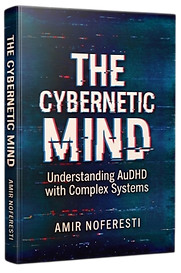
The Cybernetic Mind: Understanding AuDHD with Complex Systems
A Map for the Improbable Explorer: Departing from reductive medical models, this work reframes neurodivergence as a high-bandwidth manifestation of a Complex Adaptive System. It applies the rigors of cybernetics and Relational Frame Theory (RFT) to the cognitive landscape, offering a systemic lens for navigating the edge of chaos. For the pattern-finder and the complexity-navigator, it provides a blueprint for managing internal entropy and reclaiming the vibrant, restless symphony of the cybernetic mind.
Next in this series to be published:
The Thymotic Cybernetic: Care and Cure
The Cyborg Mind: Hoax of Neurotypical
Synapsis Via Xeniteia:
The Path of Migratory Life
The Phenomenology of Home, named for the Greek concept of Xeniteia, the state of being a stranger or an exile, this path is the journey toward a true Home in a migratory world. It addresses the Crisis of Translation faced by the migrant, transforming the pain of isolation into a regenerative phase of Intellectual Hospitality. This is the path of the Nous in transition, where we move from the deconstruction of power to the architecture of institutional equity, building a collective where every individual’s pulse is recognized.

Maîtres chez, où?
The Architecture of the Nous: A phenomenological inquiry into identity, migration, and the dream of a home in a migratory world. Moving from the necessary deconstruction of power to a regenerative phase of intellectual hospitality, this work provides an architectural blueprint for community change. It invites the reader to transition from a passive observer to an active author of the future, architecting a Quebec and a world where every individual’s pulse contributes to a resilient, united collective.
Next in this series to be published:
Meta-Colonialism: Multi-scalar Perception
Tragedy of Power in Iran
The Other Half of Iran
Synapsis Via Exemplaris:
The Path of Figures and Wisdoms
The Embodied Logos. This path is the study of Exemplars, historical and spiritual nodes through which the infinite manifests in the finite. It recognizes that wisdom is not merely an abstract data set, but a lived reality. By looking at the figures, we witness the Transubstantial Motion of leadership and the ethics of social cohesi. This path is a toolkit for recovery, taking figures who have been fractured by partisan ideologies and restoring them as global anchors for intellect, Wisdom and unity.
Ali ibn Abi Talib:
Beyond Political Islam
Intellect, Unity, and the Peak of Eloquence: An excavation of the legacy of Ali as a global anchor for Aql (Intellect) and Ittihad (Unity). This work deconstructs the partisan weaponization of a historical figure to recover a humane vision of justice and divine love (Ishq). Utilizing systemic semiotics, it bridges ancient wisdom and contemporary governance, positioning Ali as the ultimate rebuttal to radicalism and a compass for navigating a world of profound difference.

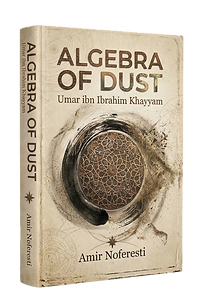
Umar Ibn Ibrahim Khayyam:
Algebra of Dust
Reason, Wine, and Cosmic Flux: An excavation of Khayyam as mathematical algorithms for deconstructing fate, unveiling intellect ('aql) as rebellion against decreed illusion. This work recovers the sensual physicist-poet from dogmatic capture, wielding rubaiyat semiotics to fuse Peripatetic precision with hedonistic ephemerality, positioning Khayyam as the supreme antidote to eschatological terror and navigator through matter's inexorable dispersal.
Next in this series to be published:
Adurbad Mahraspandan: Philosopher of Asha
Aurelius Augustinus Hipponensis: Metaphysics of Metanoia
Baal Shem Tov to Rabbi Menachem Mendel Schneerson: Philosophy of Dira BeTachtonim


Practiced Endurance to become the reliable long player.™
03_STRUCTURE
Specularis Profanum Ordinarium:
Observing the Sacred in the Mundane
I have traded the frantic pursuit of the Exit for the disciplined practice of Practiced Endurance. To be a Long Player is to understand that true value is found in the Autopoietic Resilience of a system, its ability to self-correct, maintain its internal firewall, and flourish over generations rather than quarters.

In 1971, when the Electronic News first coined the term Silicon Valley, the world witnessed the birth of a high-velocity, high-tech glamour that would define the late 20th century. It was an era of explosive growth fueled by the 1978 revision of the Prudent Man Rule, which freed investment managers from measuring risk at the individual-asset level, allowing them to bet on the aggregate portfolio instead. This structural shift birthed the modern venture capital industry, a machine designed for the frantic pursuit of the Exit, the rapid scaling and eventual liquidation of the entrepreneurial ego.
But as we navigate the cognitive load and systemic entropy of today, a new archetype is emerging from the wreckage of extraction: the Long Player.
I have rejected the extractive logic. I am my first start-up; this venture is not a product to be sold, but an Autopoietic Organism designed for mundane existence and responsible nous. This is not a pitch for a Unicorn, that $1B statistical anomaly often pursued with the predatory logic of a Vulture Capitalist. It is a pitch for Autopoietic Resilience, the capacity of an entity to self-correct, maintain its internal firewall, and flourish across generations through Practiced Endurance.
Traditional Private Equity (PE) and Venture Capital Financing have often treated firms as machine models to be optimized for efficiency and then discarded. The regenerative capitalist rejects this exhaustion of capital. Instead, business is viewed through the lens of Specularis Profanum Ordinarium, beholding the sacred within the mundane machinery of the everyday. This is the realization that the mundane machinery of the profane world, the spreadsheets, the supply chains, the daily emails, is actually a Specular Mirror reflecting the highest metaphysical truths.
Business is not a distraction from the spiritual or the philosophical; it is the laboratory where those truths are tested. By observing the Ordinary with transparency and disciplined attention, we reveal the Fractal Unity of the whole. We do not look for the sacred in the clouds; we architect it into the very structure of how we trade, build, and endure.
My philosophy of business is a recursive feedback loop. We do not seek to exploit the field; we seek to regenerate it so the game never has to end. We operate at the Edge of Chaos, balancing the need for structure with the vital infusion of novelty to prevent stagnation:
To scale this equity globally, we look beyond Mergers and Acquisitions (M&A) toward Joint Ventures and Platform Cooperatives, models of collective ownership that heal the Ecology of Mind. In a world addicted to the quick exit, the Regenerative Capitalist is a reliable Long Player, practicing the endurance of the Logos so that the game of human flourishing never has to end.
If you had asked me five years ago who I was, I would have handed you a map. I was a surveyor of truths, an architect of frameworks, deeply entrenched in the Socratic illusion that if I just thought hard enough, if I asked the right questions, I could find the ultimate Compass of Reason hovering somewhere above the messy, contradictory masks of society. I sought Ostadi, a mastery of knowledge to impose upon the world.
This is the story of how that man died, and how a Regenerative Shokunin was born in his place:

Year 1: The Aporia and The Great Death (2021–2022)
The journey did not begin with a victory; it began with a catastrophic collapse. I had spent years relying on Jiriki (self-power), convinced that my intellect could diagnose and heal the fragmented systems around me.
But the more I analyzed, the further I drifted from actual reality. I hit the absolute dead end, the Aporia.
I realized that my cherished "compass" was just another mask, a shield my ego used to avoid the terror of its own groundlessness. I was trapped in the dualism of being the "Subject" trying to fix an "Object." The breakdown of this heroic, Platonic project was my Zange, my philosophical repentance. I confessed my total inability to reach the Absolute through reason alone. I let the "Architect of Certainty" die. I stopped trying to find the compass above the masks, and instead, I allowed myself to fall into the dark, fertile soil of the unknown.
Year 2: Shugyō and the Silence of the Form (2022–2023)
Having surrendered my intellectual hubris, I entered the Basho, the Place. I realized that to regenerate anything, I first had to learn how to exist within it. I committed to Shugyō (rigorous, relentless practice).
I embraced the stage of Shu (Preservation/Obedience).

For an entire year, I shut my mind. I stopped asking "Why?" and submitted entirely to the Kata (form) of my craft. Whether I was shaping narratives, building communities, or working with my hands, I simply repeated the forms of those who came before me. I embraced the culture of Monozukuri (the soul of making), learning that true learning is somatic, not cognitive. The knowledge had to bypass my ego and sink into my bones. This was the era of building my vessel through absolute, unyielding discipline.

Year 3: The Breaking and the Uncompromising Standard (2023–2024)
As the forms of my craft became second nature, my vessel was strong enough to hold questions again. But these were no longer the arrogant questions of a philosopher; they were the precise incisions of a craftsman. I entered the phase of Ha (Breaking).
I began to deconstruct the forms to understand their structural integrity. It was here that my Kodawari emerged. This wasn't just a desire to do good work; it was an uncompromising, almost obsessive internal standard. I would tear down days of work because a hidden joint, something no one else would ever see, was imperfect. Paired with Kaizen (continuous, agonizingly small daily improvements), I stopped looking for grand, sweeping transformations and committed to the micro-evolution of the present moment. I was no longer trying to be an "Ostad" (Master); I was desperately trying to become a "Kardan" (Doer).
Year 4: The Metanoetic Shift and the Other-Power (2024–2025)
The fourth year brought the deepest paradigm shift. The exhaustion of my Jiriki (self-power) through relentless Kaizen created a profound emptiness within me. And into that void, something else rushed in. This was the Metanoetic turn. I experienced Tariki (Other-Power).

I realized that I was not the one doing the regenerating; the environment, the community, the very material I worked with was regenerating itself through me. I was merely the conduit. The Absolute Nothingness (Śūnyatā) was not a void of meaning, but a dynamic, active force. The compass was no longer "above" me; it was the very movement of my hands. My mask of the artisan had become the face of the Formless.
Year 5: The Regenerative Shokunin (2025–2026)
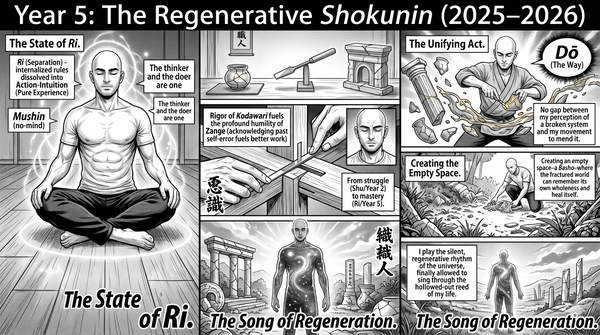
Today, I live in the stage of Ri (Separation). I no longer follow the rules, nor do I rebel against them. I have internalized them so deeply that they have dissolved into Action-Intuition (Pure Experience). There is no longer a gap between my perception of a broken system and my movement to mend it. The thinker and the doer are one.
My daily life is governed by Mushin (no-mind). When I work, I do not "think" about the work; I become the work. My craft is no longer a profession; it is my Dō (The Way).
I am a Regenerative Shokunin. I do not impose Truth upon the world. Instead, through the discipline of my craft, the rigor of my Kodawari, and the profound humility of Zange, I create an empty space, a Basho, where the fractured world can remember its own wholeness and heal itself. The music I play now is not my own; it is the silent, regenerative rhythm of the universe, finally allowed to sing through the hollowed-out reed of my life.
Year 6: The Architecture of the Invisible (2026–2027)
In the sixth year, the nature of my craft dissolved into the background. Having reached the state of Mushin (no-mind) in my own hands, I realized that true regeneration is not about fixing the object, but about nurturing the space around it. I shifted my focus from the artifact to the Basho, the Place itself.

I stopped being the artisan who repairs and became the architect of the soil. I learned the art of becoming the Kuroko, the invisible stagehands of traditional Japanese theater who move the props in absolute darkness so the play may continue seamlessly. My work lost my signature. If a community healed, if an ecosystem thrived, if a broken narrative found its wholeness, no one knew I had been there. The ego's final temptation is the desire to be recognized as a Master of the void. Slaying that temptation allowed me to embed my Kodawari (uncompromising standard) not into my own legacy, but into the very structural integrity of the environments I inhabited.

To be Continued...
I stand now at the edge of this vast, unmapped territory. The old maps are burned, and the compass has long since shattered into stardust. I pick up a raw, unshaped piece of this new reality. My hands are clumsy. My mind is perfectly empty. The horizon stretches out, terrifying and unbroken, demanding a completely new language.