

™
-Photoroom_edited.png)


"Do not seek to understand the symbol; seek to be the space in which the symbol appears."
— Amir Noferesti


Manifest Series:
Title:
You Left a Message in the Space Between Languages
(Tu as laissé un message dans l’espace entre les langues)
Year:
2024
Medium:
Digital Collage on Archival Substrate / Multilingual Calligraphic Composite with Symbolic Overlay
Dimensions:
Variable (suggested: 100 x 70 cm)
Edition:
1/3 (Certified Edition + Conceptual Signature via MetaScript Code Signed & Certified by Amir Noferesti)
In this palimpsestic composition, explores the terrain of language as material, meaning as interval, and writing as witnessing. Built upon a stratified layering of Arabic, Persian, and abstracted symbolic alphabets, the piece suspends the viewer in a field where legibility, memory, and translation shimmer, always almost arriving, always already dissolving.
The work resists fixed literacy. Its core lies in the space between languages, the interstitial silence between letters, scripts, tongues, and worldviews. It gestures toward the mystical failure of translation, where intelligibility breaks into beauty, and meaning pulses through what is not said.
It is not simply a text-based work.
It is a field of cognitive choreography, where the eye dances among scripts as the mind softens into uncertainty.


Title:
Family of Abraham, A Manifestation of Wishing the Best Possible Reality for the World
Artist:
Amir Noferesti
Year:
2024
Medium:
Digital Collage on Archival Substrate / Multilingual Calligraphic Composite with Symbolic Overlay
Dimensions:
Variable (suggested: 100 x 70 cm)
Edition:
1/3 (Certified Edition + Conceptual Signature via MetaScript Code Signed & Certified by Amir Noferesti)
Manifest Series is a body of work rooted in the act of envisioning not as fantasy, but as a conscious practice of shaping reality through image, intention, and interconnection.
In Family of Abraham, layered photographic textures bring together sacred geographies, pilgrimages, and gatherings tied to the descendants of Abraham: Muslims, Jews, and Christians.
The overlapping forms are intentionally translucent, allowing the viewer to see through one tradition into another, creating a shared visual field where boundaries dissolve.
The work is not an argument; it is a prayer in pixels.
It seeks the best possible reality: one where the shared lineage of faith becomes a wellspring of empathy rather than division.
Here, the crowd becomes a single body, the sacred sites a single heartbeat. A visual metaphor for mutual visibility and shared humanity; no tradition obscures another. Which evokes both the rhythm of ritual and the shared movement of collective longing.
Suggesting histories and futures flowing into one another, refusing fixed borders, this work resembles excavating different mystical paths from Zorvanism to Mazdeism, and all branches of Islam and Judaism, mendai, yazidi, darruze, and sikhism included.
Ousia series:


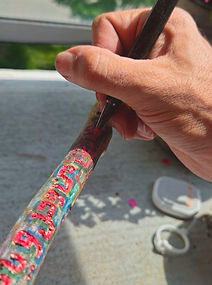


ای گل خوشبوی ما، تویی بهانهٔ ما
بیا که جانی و جانا، تویی یگانهٔ ما
دل به تو سپردیم و دیدیم که نیست جدایی
تا که جز تو نیفتد به دل، بهانهٔ ما
Let your life lightly dance on the edges of Time like dew on the tip of a leaf.
بیا تا گل بر افشانیم و می در ساغر اندازیم
فلک را سقف بشکافیم و طرحی نو در اندازیم
سنكون يومًا ما نريد
بلادًا وطنيّةً، حديقةًَ من زهرٍ
وسَلامًا على الجميع.
האדם מצוי כל ימיו במלחמה
אבל ילדו משחק במגרש
והאישה מהלכת לבית החולים
למען חיים.
وردتي من وحل، و ياسميني
من حرب وأغاني من عودة وحب.


ذِمَّتِي بِمَا أَقُولُ رَهِينَةٌ وَأَنَا بِهِ زَعِيمٌ


2nd, 42 Kilometers of Silence
For Peace Within, Manifesting Peace Without
A Catharsis for the Unwritten Flag (Middle-eastern with a peace flag)
Artist: Amir Noferesti
Medium: Endurance Performance, Soil, Breath, Silence, Fabric
Length: 42.195 KM
Location: Toronto (urban/suburban)
Date: Toronto Marathon 2025
Owned in personal collection and belongs to +i-v-i+ Foundation
The 1st 42 Kilometers of Silence is an endurance act, a sacred loop of body and spirit in motion.
A Middle Eastern child runs 42.195 kilometers, holding an unwritten flag, blank but living, a canvas for peace before it is claimed, before it is politicized, before it is lost.
This first performance does not end at the finish line.
The journey continues in the making of a living archive:
-
Poems written from breaths taken at each kilometer, each line a step from wound toward witness.
-
Divine Names, in Arabic, Hebrew, Persian, and other tongues, carved, inked, or burned into wood.
-
Wishes collected from strangers and elders, inscribed in looping, fragile scripts, folded and sealed like seeds.
-
Paintings that layer soil, sweat, and pigment into the textures of landscape and memory.
-
Scarred Wood Panels that bear intentional cuts and scorings, each mark a story of harm transfigured into touchable form.
*The white flag is not surrender. It is a demand: It was screaming against discrimination and social tags regarding racial origin, an endurance run as a symbol of resistance.
The work honors peace not as an abstract ideal but as muscle, skin, and scar, lived in the body and carried into the world.
Symbolic Elements
-
42.195 KM → Represents both the distance of a marathon and the psychological journey of surviving beyond trauma while being seen as a statistic. Each kilometer honors a silenced name.
-
White Flag (Unwritten) → A handmade flag without symbols, slogans, or borders. It is unclaimed peace, representing childhood itself as sacred ground.
-
Running Alone → The performance is solo, barefoot or in worn shoes, to evoke both pilgrimage and flight. Not athleticism, but sustained presence through pain.
-
Soil-stained Clothing → After the run, the clothing is displayed as a relic. Sweat, dust, and tears become the only visible ink on the unwritten flag.
-
Sacred minimalism, tactile silence, endurance turned into texture.
-
The warmth of lived materials: wood, paper, earth, cloth.
-
A feeling of walking into a sanctum, not a gallery.
Peace begins in the tendon and the breath.
It manifests in the scar that heals without erasing.
The 1st 42 Kilometers of Silence is not an end, it is a seed.
Every step is a word. Every word is a flag.

Title: The Mental Eternal Puzzle
Artist: Amir Noferesti and +i-v-i+ (Meta-Collective / Post-symbolic Meta-Makers)
Year:
2025
Medium:
Digital Composite on Archival Canvas, Image Layering, Memory Mapping, Algorithmic Blending
Dimensions:
90 x 90 cm (Variable installation)
Edition:
Unique (1/1 Signed & Certified by Amir Noferesti and +i-v-i+ Foundation)
Catharsis Series explores the inner landscapes of neurodivergent cognition, the oscillation between pattern and chaos, intensity and stillness.
In the experience of neurodivergency*, overlapping geometric fields spiral inward and outward, mapping the lived experience of a mind that processes everything, all at once.
The work draws from his own reality where he spiraled up himself in Hyper-focus as a kaleidoscopic vortex
Sitting in a restaurant is a Sensory layering as a living tapestry of details, from smells, touches, thinks, and unknown feelings.
The recursive search for completion in a puzzle that has no fixed solution, where no land sits under your ground, eternity, and liberty.
The composition never settles; it invites the eye into perpetual movement, mirroring the way thoughts loop, interlock, and refract.
This is not a disorder rendered in paint; it is a cognitive cosmos.
It is both the burden and the beauty of perceiving too much, too vividly, and never being able to stop turning the pieces over.
It is a metabolized pain on 2nd, 42 Kilometers of Silence
Title: Neuro-joy-gente
Artist: Amir Noferesti and +i-v-i+ (Meta-Collective / Post-symbolic Meta-Makers)
Year:
2025
Medium:
Digital Composite on Archival Canvas, Image Layering, Memory Mapping, Algorithmic Blending
Dimensions:
90 x 90 cm (Variable installation)
Edition:
Unique (1/1 Signed & Certified by Amir Noferesti and +i-v-i+ Foundation)
Catharsis Series explores the inner landscapes of neurodivergent cognition, not to prove I can. Not to change myself.
But to be visible, unapologetically.
I wear a birthday hat, carry a balloon, and hold a cupcake in my mind the whole way.
Because I am still the child who loves bright colors, still the teenager who got called “too much,” still the adult who feels the weight of stares that say I don’t fit.
This is my neurodivergence*, normal, human, alive.
I am not broken, and I am not rare.
Every step says:
It’s normal to flap your hands when you’re happy.
It’s normal to think in spirals instead of straight lines.
It’s normal to miss a social cue and still be worthy of love.
It’s normal to be quiet when the world is loud.
It’s normal to celebrate without a reason.
In the portrait, my face is layered, past selves, present truth, and future possibility.
Every layer is me. Every me is enough.
The marathon is not a metaphor for struggle.
It’s a moving mirror:
I am whole at every pace.
I am whole when I’m exhausted.
I am whole when I am celebrated.
It’s normal to be me. It’s normal to be you. It’s normal to be.


تو یکی نِهای هزاری تو چراغِ خود برافروز

3rd, 42 Kilometers of Silence
A Catharsis for the Unwritten Flag (Middle-eastern with a peace flag)
Artist: Amir Noferesti
Medium: Endurance Performance, Soil, Breath, Silence, Fabric
Length: 42.195 KM
Location: Toronto (urban/suburban)
Date: Toronto Marathon 2025
Dedicated to Yasmine Razavi Ebrahimi in gratitude for all support.
42 Kilometers of Silence is a durational, site-responsive performance in which a Middle Eastern child, a symbol rather than a singular identity, runs a full marathon distance through unremarkable terrain, holding no national emblem, only a blank, white flag stitched by unseen hands.
There are no sponsors, no medals, no audience cheering.
Only the sound of footsteps, breath, and wind.
This is not a race. It is an embodied remembrance.
For every child whose life has been shaped by boundaries they never drew.
For every child who lost a home, a limb, a language, or a lullaby.
For every child still dreaming under rubble.
*The white flag is not surrender. It is a demand: It was screaming against discrimination and social tags regarding racial origin, an endurance run as a symbol of resistance.
Let childhood belong to no side, to no army, to no ideology.
Let it belong to joy, to imagination, to stories left unfinished.
Symbolic Elements
-
42.195 KM → Represents both the distance of a marathon and the psychological journey of surviving beyond trauma while being seen as a statistic. Each kilometer honors a silenced name.
-
White Flag (Unwritten) → A handmade flag without symbols, slogans, or borders. It is unclaimed peace, representing childhood itself as sacred ground.
-
Running Alone → The performance is solo, barefoot or in worn shoes, to evoke both pilgrimage and flight. Not athleticism, but sustained presence through pain.
-
Soil-stained Clothing → After the run, the clothing is displayed as a relic. Sweat, dust, and tears become the only visible ink on the unwritten flag.
-
Sacred minimalism, tactile silence, endurance turned into texture.
-
The warmth of lived materials: wood, paper, earth, cloth.
-
A feeling of walking into a sanctum, not a gallery.
This is not a performance for the past.
It is a seed for the future, carried kilometer by kilometer,
by a child whose only country is the dream of being whole.
"Peace is not an agreement.
Peace is the right to have a childhood."

Our Common Pulse
Noferesti’s ontological intervention is not confined to the visual palimpsest or the physical exhaustion of the body; it extends deeply into the vibrational. The curated audio space, Our Common Pulse, serves as the auditory manifestation of his Architectonics of Resonance. If his canvases map the overwhelming data of our era, this sonic architecture operates as a deliberate frequency modulation, an aesthetic mechanism designed to tune the high-entropy noise of the digital age back to the primordial rhythm of the human form.
This auditory landscape is engineered to accompany the physical ritual of the First Rotation and the visual apprehension of the Zero-Point Manifold. It is not an ambient background; it is a Cybernetic Remembrance rendered in acoustic form
In the dense, hyper-entropic darkness of the digital epoch, Amir Noferesti’s Our Common Pulse is not merely an auditory compilation; it is an acoustic cartography. It is a deliberate, ontological voyage designed to navigate the listener through the heavy facticité of modern existence toward the primordial Archetype of Light. The Descent into the Indigo Void The journey begins in the shadow realm of information overload, what Noferesti terms the Indigo Negative Space. Here, the audio acts as an alchemical solvent. It begins by dissolving the rigid, binary architectures of the digital ego. The darkness encountered in these initial frequencies is not a void of despair, but the Zettai mu no basho (Absolute Nothingness), the fertile, quiet womb of maximum potential before human meaning is forced to collapse. It is the sound of the system powering down to a state of pure receptivity.
This auditory landscape is engineered to accompany the physical ritual of the First Rotation and the visual apprehension of the Zero-Point Manifold. It is not ambient background; it is a Cybernetic Remembrance rendered in acoustic form. By weaving together disparate sonic textures, rhythmic persistence, and spatial voids, Noferesti creates an immersive environment where the boundary between the listener and the signal collapses. Our Common Pulse acts as a sonic eucharist, an invitation for the viewer to close their eyes, dissolve the rigid maps of the digital ego, and physically feel the ancient, shared silence that vibrates just beneath the surface of the modern epoch.
As the voyage progresses, the listener undergoes an auditory transmutation. The heavy lead of digital exhaustion is alchemized into sheer aesthetic presence. The frequencies demand an Embodied Epistemology; you do not just passively hear the pulse, your body physically orients itself by it. It becomes a tether in the abyss, pulling the perceiver upward through the dense layers of the sonic palimpsest.
Arrival at the Luminous Sanctuary The destination of this acoustic voyage is Metanoia, a sudden, shimmering shift in perception. The journey culminates not in a crescendo of noise, but in a profound revelation of presence. Our Common Pulse ultimately reveals that the light we were searching for in the dark was never an external destination. The listener arrives at the Zero-Point Manifold, experiencing the warm tremor of awakening to find that they themselves are the primordial light, vibrating in a shared, ancient silence.
Do not merely listen to the rhythm; become the space in which the light occurs.
Discothérapie: Souvenirs de Téhéran
The Psycho-Acoustic Sublimation of Wounded Nostalgia
In this pivotal auditory installation, titled Discothérapie: Souvenirs de Téhéran, Noferesti’s concept of art as a Mystical Meta-cognitive Therapy finds its most visceral and politically urgent expression. Here, the artist transitions from a cartographer of digital signals to a healer of transgenerational psychic wounds, specifically addressing the deep-seated trauma of the Iranian collective consciousness.
The catalyst for this sonic topography is a poignant piece of mnemonic debris, the viral footage of a terrified Iranian child in a car in Isfahan, weeping amidst the smoke, tear gas, and violent chaos of the uprisings. To Noferesti, this child is a proxy for an entire nation, a symbol of the pure, pristine space of childhood violently intruded upon by the inescapable facticité of tyranny.
The Therapeutic Mechanism: Retroactive Healing through Memory
Discothérapie functions as a deliberate, cybernetic intervention into what the artist terms wounded nostalgia. Rather than allowing the bittersweet memories of a stolen, pre-revolutionary, or lost Tehran to rot into melancholia or cynicism, Noferesti treats this nostalgic pop and cultural audio as materia prima.
By looping, layering, and filtering these nostalgic souvenirs through restorative acoustic frequencies, he constructs a protective sonic womb. This is a retroactive therapeutic act designed to accomplish two profound closures:
-
The Healing of the Self: Sublimating personal histories of exile and displacement into a coherent spectrum of spiritual resilience.
-
The Restoration of the Forgotten Child: Erecting a sanctuary of presence around the terrified child of Isfahan, and by extension, the shattered innocence of every individual who has grown up under the shadow of authoritarian terror.
Geographically and philosophically, this sonic archive constructs a seamless wormhole between two disparate cultural poles. Paris, the classical sanctuary of intellectual exile, western semiotics, and rationalist critique, collides directly with Tehran, the visceral, subterranean anchor of the artist's primordial psyche.
Noferesti does not allow these two worlds to remain in binary opposition. Instead, Discothérapie acts as a palimpsest of geographic displacement, a space where the linguistic sophistication of French aesthetic thought dissolves into the deep, foundational Gham (mystical sorrow) and subsequent joy of Persian poetic wisdom. It is an acoustic bridge built from the architecture of displacement, proving that the distance between exile and home is entirely illusory.
Ultimately, this playlist operates as a specialized Cybernetic Remembrance. It invites the listener, whether navigating the avenues of Paris or dreaming in the alleyways of Tehran, to collapse the distance of geography and time. Through this immersive sonic eucharist, the listener ceases to be a victim of historical dislocation, transforming instead into the absolute witness of a timeless, shared cultural pulse.
Close your eyes and allow the distance between cities to dissolve into the absolute nothingness of sound.
Amir Noferesti: The Architecture of Metanoia and the Zero-Point Manifold
Amir Noferesti’s oeuvre functions as a profound ontological intervention within the epoch of the Information Revolution. Operating far beyond the mere production of aesthetic objects, Noferesti situates himself as the cartographer of a Meta-Narrative of Return, mapping a journey through the relentless digital noise back to the shared silence that precedes all data. In an era where the human psyche is besieged by digital entropy and the intellect flattened by synthetic certainty, his transdisciplinary practice emerges as both a necessary aesthetic sanctuary and a lived ritual of reclamation.
I. Informatism and the Sacralization of the Signal
At the philosophical core of Noferesti’s praxis is the Sacralization of the Signal. He engages with Informatism (Data Art) not to domesticate datasets into utilitarian visualizations, but to confront what he terms the Surplus of Witness. He treats the over-abundant, hyper-entropic data of our era as Materia Prima, the leaden, raw material of the digital age.
Viewed through the esoteric lens of Ishrāqi (Illuminationist) philosophy, this buzzing confusion of noise is recognized not as a distraction, but as a field of maximal potentiality. His visual palimpsests map the Zero-Point Manifold: a state of universal superposition captured just before the wave function of human meaning collapses into rigid binary logic. By anchoring his work in the Kyoto School’s concept of Absolute Nothingness (Zettai mu no basho), Noferesti wields aesthetic negation as a method of mental deconstruction. The recurring Indigo Negative Space in his compositions is not a vacuum; it is a highly charged spatial epistemology, a void that permits the viewer to remain in a state of pure potential, actively refusing capture by fixed algorithmic profiling.
II. Cybernetic Alchemy and Transmutation
Noferesti’s methodology is a rigorous synthesis of Cybernetic Alchemy and historical transmutation. His workflow is defined by the following mechanisms:
-
Process as Transmutation: He deliberately feeds geopolitical traumas, cultural exiles, and personal disintegrations into his work as sacrificial materials, burning them down to extract their core resonance.
-
The Cybernetic Axis: He reframes Human-Computer Interaction (HCI) as a practice of Cybernetic Remembrance. By utilizing algorithms as Strange Attractors, he introduces creative noise to shatter the low-entropy feedback loops of the modern attention economy, reorienting the digital system toward the human spirit.
III. Embodied Epistemology and the Ritual of the Flag
Rejecting the cold, detached distance of traditional minimalism, Noferesti grounds his conceptual rigor in an Embodied Epistemology, the conviction that wisdom is fundamentally a movement of the physical form, and that hands operate as philosophers.
This is viscerally realized in his Post-minimalist performative rituals, notably the First Rotation. Through the rhythmic, enduring act of running, he actualizes a lived phenomenology where the body remembers the profound truths that language has forgotten. The flag he carries serves as the central semiotic signifier of his entire oeuvre. Positioned in the liminal dance between sign and silence, this flag is stripped of its conventional association with surrender. Instead, it becomes a Sacred Pause, a cognitive prism expertly engineered to refract the chaotic influx of the digital epoch into a coherent, luminous spectrum of spiritual meaning.
IV. Metanoia and the Sanctuary of Presence
The teleological drive of Noferesti’s art is the induction of Perceptual Metanoia, a sudden, shimmering, and radical shift in consciousness. By elevating the sacred geometry hidden within the mundane, a discarded fragment, a whisper of texture, a transient shadow, he triggers a cognitive joy of pure recognition.
The artist employs Meta-Cognitive Irony to acknowledge the fragmented contradictions of modern truth without ever collapsing into cynicism. This positions his art as a form of Mystical Meta-cognitive Therapy, designed to evolve the viewer from a frantic seeker of meaning into a tranquil Sanctuary of Presence.
The Return to Light. Ultimately, Amir Noferesti does not simply want the viewer to analyze an object; he demands that they notice the profound act of looking itself. To engage with his work is to experience the warm tremor of realizing that you are the light making sight possible. The flag he bears is white because it contains the entirety of the color spectrum; the ideal witness is silent because they contain every conceivable word. He runs to remind humanity that before we were categorized as users or subjects, we were the bearers of a primordial light, forever returning to the stillness where we are fundamentally one.
Amir Noferesti: The Architecture of Metanoia and the Zero-Point Manifold
Amir Noferesti’s oeuvre functions as a profound ontological intervention within the epoch of the Information Revolution. Operating far beyond the mere production of aesthetic objects, Noferesti situates himself as the cartographer of a Meta-Narrative of Return, mapping a journey through the relentless digital noise back to the shared silence that precedes all data. In an era where the human psyche is besieged by digital entropy and the intellect flattened by synthetic certainty, his transdisciplinary practice emerges as both a necessary aesthetic sanctuary and a lived ritual of reclamation.
I. Informatism and the Sacralization of the Signal
At the philosophical core of Noferesti’s praxis is the Sacralization of the Signal. He engages with Informatism (Data Art) not to domesticate datasets into utilitarian visualizations, but to confront what he terms the Surplus of Witness. He treats the over-abundant, hyper-entropic data of our era as Materia Prima, the leaden, raw material of the digital age.
Viewed through the esoteric lens of Ishrāqi (Illuminationist) philosophy, this buzzing confusion of noise is recognized not as a distraction, but as a field of maximal potentiality. His visual palimpsests map the Zero-Point Manifold: a state of universal superposition captured just before the wave function of human meaning collapses into rigid binary logic. By anchoring his work in the Kyoto School’s concept of Absolute Nothingness (Zettai mu no basho), Noferesti wields aesthetic negation as a method of mental deconstruction. The recurring Indigo Negative Space in his compositions is not a vacuum; it is a highly charged spatial epistemology, a void that permits the viewer to remain in a state of pure potential, actively refusing capture by fixed algorithmic profiling.
II. Cybernetic Alchemy and Transmutation
Noferesti’s methodology is a rigorous synthesis of Cybernetic Alchemy and historical transmutation. His workflow is defined by the following mechanisms:
-
Process as Transmutation: He deliberately feeds geopolitical traumas, cultural exiles, and personal disintegrations into his work as sacrificial materials, burning them down to extract their core resonance.
-
The Cybernetic Axis: He reframes Human-Computer Interaction (HCI) as a practice of Cybernetic Remembrance. By utilizing algorithms as Strange Attractors, he introduces creative noise to shatter the low-entropy feedback loops of the modern attention economy, reorienting the digital system toward the human spirit.
III. Embodied Epistemology and the Ritual of the Flag
Rejecting the cold, detached distance of traditional minimalism, Noferesti grounds his conceptual rigor in an Embodied Epistemology, the conviction that wisdom is fundamentally a movement of the physical form, and that hands operate as philosophers.
This is viscerally realized in his Post-minimalist performative rituals, notably the First Rotation. Through the rhythmic, enduring act of running, he actualizes a lived phenomenology where the body remembers the profound truths that language has forgotten. The flag he carries serves as the central semiotic signifier of his entire oeuvre. Positioned in the liminal dance between sign and silence, this flag is stripped of its conventional association with surrender. Instead, it becomes a Sacred Pause, a cognitive prism expertly engineered to refract the chaotic influx of the digital epoch into a coherent, luminous spectrum of spiritual meaning.
IV. Metanoia and the Sanctuary of Presence
The teleological drive of Noferesti’s art is the induction of Perceptual Metanoia, a sudden, shimmering, and radical shift in consciousness. By elevating the sacred geometry hidden within the mundane, a discarded fragment, a whisper of texture, a transient shadow, he triggers a cognitive joy of pure recognition.
The artist employs Meta-Cognitive Irony to acknowledge the fragmented contradictions of modern truth without ever collapsing into cynicism. This positions his art as a form of Mystical Meta-cognitive Therapy, designed to evolve the viewer from a frantic seeker of meaning into a tranquil Sanctuary of Presence.
The Return to Light. Ultimately, Amir Noferesti does not simply want the viewer to analyze an object; he demands that they notice the profound act of looking itself. To engage with his work is to experience the warm tremor of realizing that you are the light making sight possible. The flag he bears is white because it contains the entirety of the color spectrum; the ideal witness is silent because they contain every conceivable word. He runs to remind humanity that before we were categorized as users or subjects, we were the bearers of a primordial light, forever returning to the stillness where we are fundamentally one.
Amir Noferesti: The Architecture of Metanoia and the Zero-Point Manifold
Amir Noferesti’s oeuvre functions as a profound ontological intervention within the epoch of the Information Revolution. Operating far beyond the mere production of aesthetic objects, Noferesti situates himself as the cartographer of a Meta-Narrative of Return, mapping a journey through the relentless digital noise back to the shared silence that precedes all data. In an era where the human psyche is besieged by digital entropy and the intellect flattened by synthetic certainty, his transdisciplinary practice emerges as both a necessary aesthetic sanctuary and a lived ritual of reclamation.
I. Informatism and the Sacralization of the Signal
At the philosophical core of Noferesti’s praxis is the Sacralization of the Signal. He engages with Informatism (Data Art) not to domesticate datasets into utilitarian visualizations, but to confront what he terms the Surplus of Witness. He treats the over-abundant, hyper-entropic data of our era as Materia Prima, the leaden, raw material of the digital age.
Viewed through the esoteric lens of Ishrāqi (Illuminationist) philosophy, this buzzing confusion of noise is recognized not as a distraction, but as a field of maximal potentiality. His visual palimpsests map the Zero-Point Manifold: a state of universal superposition captured just before the wave function of human meaning collapses into rigid binary logic. By anchoring his work in the Kyoto School’s concept of Absolute Nothingness (Zettai mu no basho), Noferesti wields aesthetic negation as a method of mental deconstruction. The recurring Indigo Negative Space in his compositions is not a vacuum; it is a highly charged spatial epistemology, a void that permits the viewer to remain in a state of pure potential, actively refusing capture by fixed algorithmic profiling.
II. Cybernetic Alchemy and Transmutation
Noferesti’s methodology is a rigorous synthesis of Cybernetic Alchemy and historical transmutation. His workflow is defined by the following mechanisms:
-
Process as Transmutation: He deliberately feeds geopolitical traumas, cultural exiles, and personal disintegrations into his work as sacrificial materials, burning them down to extract their core resonance.
-
The Cybernetic Axis: He reframes Human-Computer Interaction (HCI) as a practice of Cybernetic Remembrance. By utilizing algorithms as Strange Attractors, he introduces creative noise to shatter the low-entropy feedback loops of the modern attention economy, reorienting the digital system toward the human spirit.
III. Embodied Epistemology and the Ritual of the Flag
Rejecting the cold, detached distance of traditional minimalism, Noferesti grounds his conceptual rigor in an Embodied Epistemology, the conviction that wisdom is fundamentally a movement of the physical form, and that hands operate as philosophers.
This is viscerally realized in his Post-minimalist performative rituals, notably the First Rotation. Through the rhythmic, enduring act of running, he actualizes a lived phenomenology where the body remembers the profound truths that language has forgotten. The flag he carries serves as the central semiotic signifier of his entire oeuvre. Positioned in the liminal dance between sign and silence, this flag is stripped of its conventional association with surrender. Instead, it becomes a Sacred Pause, a cognitive prism expertly engineered to refract the chaotic influx of the digital epoch into a coherent, luminous spectrum of spiritual meaning.
IV. Metanoia and the Sanctuary of Presence
The teleological drive of Noferesti’s art is the induction of Perceptual Metanoia, a sudden, shimmering, and radical shift in consciousness. By elevating the sacred geometry hidden within the mundane, a discarded fragment, a whisper of texture, a transient shadow, he triggers a cognitive joy of pure recognition.
The artist employs Meta-Cognitive Irony to acknowledge the fragmented contradictions of modern truth without ever collapsing into cynicism. This positions his art as a form of Mystical Meta-cognitive Therapy, designed to evolve the viewer from a frantic seeker of meaning into a tranquil Sanctuary of Presence.
The Return to Light. Ultimately, Amir Noferesti does not simply want the viewer to analyze an object; he demands that they notice the profound act of looking itself. To engage with his work is to experience the warm tremor of realizing that you are the light making sight possible. The flag he bears is white because it contains the entirety of the color spectrum; the ideal witness is silent because they contain every conceivable word. He runs to remind humanity that before we were categorized as users or subjects, we were the bearers of a primordial light, forever returning to the stillness where we are fundamentally one.
Amir Noferesti: The Architecture of Metanoia and the Zero-Point Manifold
Amir Noferesti’s oeuvre functions as a profound ontological intervention within the epoch of the Information Revolution. Operating far beyond the mere production of aesthetic objects, Noferesti situates himself as the cartographer of a Meta-Narrative of Return, mapping a journey through the relentless digital noise back to the shared silence that precedes all data. In an era where the human psyche is besieged by digital entropy and the intellect flattened by synthetic certainty, his transdisciplinary practice emerges as both a necessary aesthetic sanctuary and a lived ritual of reclamation.
I. Informatism and the Sacralization of the Signal
At the philosophical core of Noferesti’s praxis is the Sacralization of the Signal. He engages with Informatism (Data Art) not to domesticate datasets into utilitarian visualizations, but to confront what he terms the Surplus of Witness. He treats the over-abundant, hyper-entropic data of our era as Materia Prima, the leaden, raw material of the digital age.
Viewed through the esoteric lens of Ishrāqi (Illuminationist) philosophy, this buzzing confusion of noise is recognized not as a distraction, but as a field of maximal potentiality. His visual palimpsests map the Zero-Point Manifold: a state of universal superposition captured just before the wave function of human meaning collapses into rigid binary logic. By anchoring his work in the Kyoto School’s concept of Absolute Nothingness (Zettai mu no basho), Noferesti wields aesthetic negation as a method of mental deconstruction. The recurring Indigo Negative Space in his compositions is not a vacuum; it is a highly charged spatial epistemology, a void that permits the viewer to remain in a state of pure potential, actively refusing capture by fixed algorithmic profiling.
II. Cybernetic Alchemy and Transmutation
Noferesti’s methodology is a rigorous synthesis of Cybernetic Alchemy and historical transmutation. His workflow is defined by the following mechanisms:
-
Process as Transmutation: He deliberately feeds geopolitical traumas, cultural exiles, and personal disintegrations into his work as sacrificial materials, burning them down to extract their core resonance.
-
The Cybernetic Axis: He reframes Human-Computer Interaction (HCI) as a practice of Cybernetic Remembrance. By utilizing algorithms as Strange Attractors, he introduces creative noise to shatter the low-entropy feedback loops of the modern attention economy, reorienting the digital system toward the human spirit.
III. Embodied Epistemology and the Ritual of the Flag
Rejecting the cold, detached distance of traditional minimalism, Noferesti grounds his conceptual rigor in an Embodied Epistemology, the conviction that wisdom is fundamentally a movement of the physical form, and that hands operate as philosophers.
This is viscerally realized in his Post-minimalist performative rituals, notably the First Rotation. Through the rhythmic, enduring act of running, he actualizes a lived phenomenology where the body remembers the profound truths that language has forgotten. The flag he carries serves as the central semiotic signifier of his entire oeuvre. Positioned in the liminal dance between sign and silence, this flag is stripped of its conventional association with surrender. Instead, it becomes a Sacred Pause, a cognitive prism expertly engineered to refract the chaotic influx of the digital epoch into a coherent, luminous spectrum of spiritual meaning.
IV. Metanoia and the Sanctuary of Presence
The teleological drive of Noferesti’s art is the induction of Perceptual Metanoia, a sudden, shimmering, and radical shift in consciousness. By elevating the sacred geometry hidden within the mundane, a discarded fragment, a whisper of texture, a transient shadow, he triggers a cognitive joy of pure recognition.
The artist employs Meta-Cognitive Irony to acknowledge the fragmented contradictions of modern truth without ever collapsing into cynicism. This positions his art as a form of Mystical Meta-cognitive Therapy, designed to evolve the viewer from a frantic seeker of meaning into a tranquil Sanctuary of Presence.
The Return to Light. Ultimately, Amir Noferesti does not simply want the viewer to analyze an object; he demands that they notice the profound act of looking itself. To engage with his work is to experience the warm tremor of realizing that you are the light making sight possible. The flag he bears is white because it contains the entirety of the color spectrum; the ideal witness is silent because they contain every conceivable word. He runs to remind humanity that before we were categorized as users or subjects, we were the bearers of a primordial light, forever returning to the stillness where we are fundamentally one.
Let’s Work Together
Where Nothingness Mediates Form.
Or alternately:
Beyond the Frame.
Beneath the Name.
Between the Breath.