


The premise that the mind operates like a machine, a computational device processing discrete inputs into predictable outputs, has been the dominant epistemological model of the West for over three centuries. However, as our understanding of complexity, biology, and ecology has deepened, this mechanistic metaphor has proven fundamentally inadequate.
Bienvenue in Organic Thinking:
A cognitive framework that models human thought, perception, and societal structures not on the architecture of engines or computers, but on the dynamic, non-linear, and self-organizing properties of living systems. At its core, organic thinking posits that cognition is an interconnected web of relations, where systems of thought are evolving networks of interdependent elements.
This research explores the philosophical foundations, scientific frameworks, and practical applications of the organic cognitive paradigm.


Conceptual and Theoretical Foundations
The transition toward organic thinking is not merely a poetic shift in metaphor; it is a rigorous evolution grounded in 20th-century systems science, cybernetics, and biology.
Historically, science relied on reductionism—the belief that to understand a complex entity, one must break it down into its smallest, isolated parts. Ludwig von Bertalanffy’s General Systems Theory challenged this, asserting that living entities are "open systems" characterized by continuous interactions with their environment. In a system, the relationships between the parts are more important than the parts themselves.
Simultaneously, thinkers like Norbert Wiener and Gregory Bateson introduced Cybernetics, the study of circular causality and feedback loops. In his seminal work Steps to an Ecology of Mind, Bateson argued that the mind is not localized in the brain alone, but is an ecological subsystem interconnected with the body and the environment. To think organically is to think in loops, recognizing that every action ripples through the web and feeds back into the source.
In the 1970s, Chilean biologists Humberto Maturana and Francisco Varela introduced the concept of Autopoiesis (self-creation) to define the nature of living systems. An autopoietic system (like a cell) continuously regenerates the very network of processes that produced it.
When applied to cognition, Maturana and Varela developed Enactivism. Enactivism argues that cognition is not the passive reception of external "data" (like a camera taking a picture), but a continuous, active process of bringing forth a world through the organism's lived interaction with its environment. Thought is a living metabolism; it breathes, adapts, and evolves in structural coupling with its surroundings.
In philosophy, Gilles Deleuze and Félix Guattari provided the ultimate blueprint for the "interconnected web of relations" with their concept of the Rhizome. Unlike a traditional tree (arborescent thought), which is hierarchical, linear, and stems from a single root, a rhizome (like a fungal mycelium or a ginger root) connects any point to any other point. Organic thinking is fundamentally rhizomatic; it does not follow a strict deductive ladder but branches out, cross-pollinates, and creates unexpected conceptual alliances.
Key Principles of Organic Thought
When we engage in organic thinking, we apply specific cognitive lenses to the world around us:
-
Emergence: Organic thinkers recognize that when elements interact in a web, they produce phenomena that cannot be predicted by analyzing the elements in isolation. (e.g., You cannot understand the concept of "wetness" by studying isolated hydrogen and oxygen atoms; wetness is an emergent property of their relationship).
-
Context-Responsiveness: A mechanistic part functions the same way everywhere (a spark plug does the same thing in any engine). A living element changes based on its environment (a stem cell becomes bone, blood, or brain tissue depending on its surrounding chemical context). Organic thinking insists that truth and meaning are always deeply contextual.
-
Symbiosis and Mutual Definition: In an interconnected web of relations, concepts do not possess inherent, standalone identities. They mutually define one another. "Light" has no meaning without "dark"; "individual" has no meaning without "community."
The crises of the 21st century, climate change, global pandemics, economic volatility, and the advent of complex artificial intelligence, are fundamentally systemic crises. They cannot be solved by mechanistic, linear thinking, which often attempts to fix one isolated problem only to cause devastating unintended consequences elsewhere in the web.
Organic thinking is no longer an alternative philosophical luxury; it is an evolutionary imperative. By retraining our cognition to see the world as an evolving network of interdependent elements, by thinking in loops, networks, and contexts, we align our minds with the actual architecture of reality. We cease operating as mechanics trying to fix the world, and step into our proper role as gardeners, tending to the vast, living web of relations of which we are intrinsically a part.
The transition from a mechanistic worldview to an organic, systems-based paradigm represents one of the most profound intellectual shifts of our time. As you highlighted, the crises we face, ecological collapse, economic volatility, and profound social alienation, are not merely political or technological failures. They are epistemological failures. We have been trying to navigate a deeply entangled, living world using the maps of a clockmaker.
To fully grasp and apply this "organic thinking," we must synthesize the historical, philosophical, and scientific currents that have brought us to this tipping point, moving from the illusion of linear control to the reality of dynamic interconnectedness.
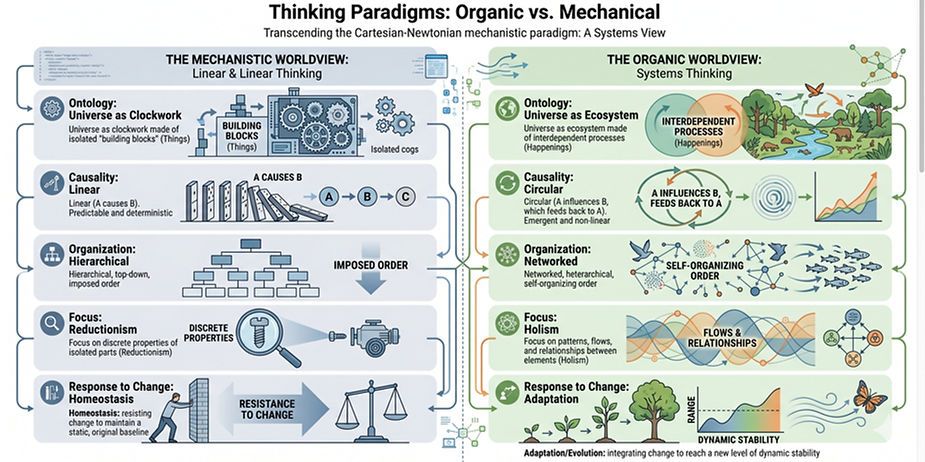
Principles of Organic Thought
When we engage in organic thinking, we apply specific cognitive lenses to the world around us:
-
Emergence: Organic thinkers recognize that when elements interact in a web, they produce phenomena that cannot be predicted by analyzing the elements in isolation. (e.g., You cannot understand the concept of "wetness" by studying isolated hydrogen and oxygen atoms; wetness is an emergent property of their relationship).
-
Context-Responsiveness: A mechanistic part functions the same way everywhere (a spark plug does the same thing in any engine). A living element changes based on its environment (a stem cell becomes bone, blood, or brain tissue depending on its surrounding chemical context). Organic thinking insists that truth and meaning are always deeply contextual.
-
Symbiosis and Mutual Definition: In an interconnected web of relations, concepts do not possess inherent, standalone identities. They mutually define one another. "Light" has no meaning without "dark"; "individual" has no meaning without "community."
The crises of the 21st century, climate change, global pandemics, economic volatility, and the advent of complex artificial intelligence, are fundamentally systemic crises. They cannot be solved by mechanistic, linear thinking, which often attempts to fix one isolated problem only to cause devastating unintended consequences elsewhere in the web.
Organic thinking is no longer an alternative philosophical luxury; it is an evolutionary imperative. By retraining our cognition to see the world as an evolving network of interdependent elements, by thinking in loops, networks, and contexts, we align our minds with the actual architecture of reality. We cease operating as mechanics trying to fix the world, and step into our proper role as gardeners, tending to the vast, living web of relations of which we are intrinsically a part.
The transition from a mechanistic worldview to an organic, systems-based paradigm represents one of the most profound intellectual shifts of our time. As you highlighted, the crises we face, ecological collapse, economic volatility, and profound social alienation, are not merely political or technological failures. They are epistemological failures. We have been trying to navigate a deeply entangled, living world using the maps of a clockmaker.
To fully grasp and apply this "organic thinking," we must synthesize the historical, philosophical, and scientific currents that have brought us to this tipping point, moving from the illusion of linear control to the reality of dynamic interconnectedness.
The Anatomy of the Mechanistic Mindset
The mechanistic paradigm, crystallized during the 17th-century Scientific Revolution by thinkers like Descartes and Newton, relies on reductionism and linear causality. It operates on a few core, often unspoken, assumptions:
-
Atomism: The belief that the fundamental reality of any system is found in its smallest, isolated parts.
-
Determinism: The belief that if you know the initial conditions and the laws of motion, you can perfectly predict the future (the "clockwork universe").
-
Separation: The strict division between mind and matter, observer and observed, humanity and nature.
This approach gave us the Industrial Revolution, modern surgery, and classical computing. But when applied to complex adaptive systems (like a rainforest, a global economy, or a human mind), reductionism becomes destructive. It creates "silos": we have neurologists who don't study the gut biome, economists who treat ecological limits as "externalities," and education systems that measure intelligence via standardized testing while ignoring emotional development.
The Rise of Organicism: From Philosophy to Complexity Science
Organic thinking corrects this blindness by recognizing that the universe is not a collection of objects, but a communion of subjects and processes.
The Philosophical Bedrock Long before modern science, organicism thrived. From Heraclitus’s Panta Rhei (everything flows) to Indigenous epistemologies that view rivers and forests as kin, the relational view of reality is ancient. In the 20th century, Alfred North Whitehead’s Process Philosophy gave this formal rigor. Whitehead argued against "the fallacy of misplaced concreteness, our tendency to mistake abstract models for reality. For Whitehead, the universe is not made of "stuff" (nouns); it is made of "actual occasions" or interdependent events (verbs).
The Cybernetic and Systems Revolution In the mid-20th century, Ludwig von Bertalanffy (General Systems Theory) and Gregory Bateson (Cybernetics) gave organic thinking a scientific lexicon. Bateson famously asked what "pattern connects the crab to the lobster and the orchid to the primrose?" The answer was information and feedback loops. Systems theory proved that biological and social structures are "open systems." They only survive by metabolizing energy and information from their environment.
Autopoiesis and Enactivism (The Biology of Mind) Perhaps the most radical leap in organic thinking came from Chilean biologists Humberto Maturana and Francisco Varela. They coined Autopoiesis (self-creation) to describe how living systems continuously regenerate themselves. They later expanded this into Enactivism, shattering the "brain-as-computer" metaphor. A brain does not passively "process inputs" from an objective world. Instead, the organism and the environment mutually co-create each other through a process of sense-making. Knowing is not storing data; knowing is doing and living.


Applications of Organic Thinking in Various Fields
Because organic thinking provides a flexible, holistic framework, it has wide-ranging applications. Many domains facing complexity and change have adopted living-systems principles to inform practice. Here are a few areas and how the concept is applied or could be applied:
-
Education and Learning: Educators have increasingly recognized the importance of systems and context in learning – essentially applying organic thinking to education. Holistic education approaches treat the learner as an integrated being (mind, body, emotion) and stress connectedness of knowledge. Systems thinking in curricula helps students see interconnections in ecology, social studies, and science. For example, the Center for Ecoliteracy advocates teaching students that “everything in the world is connected to other things” and that individual things (plants, people, schools) “cannot be fully understood apart from the larger systems in which they exist.” The goal is to encourage youth to think in terms of relationships, connectedness, and context. This might involve project-based learning, interdisciplinary lessons, and real-world problem solving that highlight how different factors form a whole. An art teacher, for instance, might have students draw a bee within its ecosystem rather than as an isolated diagram – illustrating part-whole context. In general, an organic approach to education emphasizes growth and development (like nurturing a plant) rather than simply “mechanistically” inputting facts. It aligns with constructivist theories (students actively build knowledge) and encourages adaptability, creativity, and collaborative learning (the “ecosystem” of a classroom).
-
Leadership and Organizational Development: The business and organizational realm has explicitly contrasted mechanistic vs. organic models of structure and leadership. Classic management theory (Burns & Stalker, 1961) distinguished mechanistic organizations – rigid hierarchies suited to stable conditions – from organic organizations, which are flexible, networked, and adaptive in turbulent environments. In an organic organization, communication is network-like rather than top-down, roles are more generalized, and teams self-adjust to change. This enables quick response to environmental shifts and fosters innovation. Modern management thinkers have built on these ideas: Peter Senge’s learning organization concept encourages seeing the company as an integrated system that “continuously transforms itself” and empowers individuals to adapt and grow. Margaret Wheatley, in Leadership and the New Science, urges leaders to learn from chaos theory and biology, promoting “self-organizing” teams, distributed decision-making, and an acceptance of uncertainty. She notes that overly rigid control can undermine an organization’s long-term survival in a changing world. In practice, this means a leader acts less like a controller/engineer and more like a gardener or facilitator – setting vision and values (the “guiding principles”) but allowing teams to innovate, experiment, and self-correct. Concepts such as “Agile” management and complexity leadership are implementations of organic thinking: they focus on iterative adaptation, cross-functional collaboration, and learning from feedback rather than executing a fixed plan. Overall, treating an organization as a living system (with a culture, evolving knowledge, and interconnected departments) has proven effective for fostering resilience and creativity, especially in fast-changing industries.
-
Creativity and Innovation: Organic thinking often comes naturally in creative endeavors, where rigidity can stifle originality. In fields like design, technology innovation, or the arts, an organic approach means trusting emergent processes – allowing ideas to incubate, mutate, and recombine in novel ways, rather than following a strict linear method. Brainstorming sessions that “let any idea connect to any other” without premature filtering are an example (mimicking the way diverse elements in an ecosystem might unexpectedly combine to yield a new form). Iterative design methodologies (such as design thinking) also echo organic principles: designers prototype rapidly, get feedback (environment response), and iteratively refine the solution, akin to an evolutionary selection process. This non-linear loop contrasts with a linear “waterfall” design process. Biomimicry is a direct application of organic thinking to innovation and design – it literally learns from living systems. As defined by the Biomimicry Institute, “biomimicry is a practice that learns from and mimics the strategies used by living organisms to solve challenges… The goal is to create products, processes, and systems that solve our problems sustainably and in harmony with all life”. Designers have studied how leaves efficiently capture solar energy to improve solar panels, how termite mounds self-regulate temperature to design better building ventilation, etc. This approach requires seeing nature as a teacher (an interconnected web of evolved solutions) rather than as inert matter – a quintessentially organic mindset. In artistic creativity, organic thinking might manifest as improvisation (e.g. jazz ensembles self-organize a coherent piece through mutual feedback), or in narrative and visual arts that emphasize process and emergence (e.g. generative art that grows patterns via algorithmic “life”). Overall, innovation thrives on flexibility, cross-pollination of ideas, and adaptation – all hallmarks of organic thinking. It acknowledges that creative evolution can be more effective than top-down invention.
-
Design and Architecture: Approaches like permaculture in design apply living-systems thinking to agriculture and land-use, arranging elements (plants, water flows, structures) in self-sustaining patterns that mimic natural ecosystems (yielding resilient, low-waste farms). In architecture, pioneers like Frank Lloyd Wright advocated “organic architecture” – designing buildings in harmony with their environment and with integrated form and function (his famous quote, “form and function are one”, reflects an organic unity). Contemporary sustainable design also treats a building as a living system (integrating energy flows, natural lighting, green roofs, etc. that respond to climate). Service design and social innovation increasingly use system maps and human-centered methods to capture the whole context of a problem (social, environmental, user experience) rather than solving one piece in isolation. All these trends illustrate a shift from seeing a design as a static end-product to seeing it as part of ongoing processes – use, maintenance, adaptation over time – much like a living entity that has a lifecycle.
-
Organizational and Community Development: In community planning, governance, and social change initiatives, organic thinking leads to concepts like “network governance” (decentralized, peer-to-peer collaboration) and emergent strategy. Activist and author adrienne maree brown, for example, writes about Emergent Strategy inspired by nature’s adaptability – encouraging communities to self-organize, to find small interventions that spiral into larger change, and to remain responsive to feedback. Ecosystem mapping is used in community development to see how different actors (nonprofits, businesses, agencies, citizens) interrelate, aiming to strengthen the whole network’s health rather than just optimizing one organization. Even in economics, ideas like circular economies or regenerative economics draw from living system models (nutrient cycles, mutualism) to create sustainable communities. In therapy and psychology, family systems theory sees an individual’s behavior as arising from the family system’s dynamics – again a holistic, context-rich approach versus treating the person as an isolated machine. All these applications attest to the broad utility of organic thinking whenever problems are complex, interconnected, and dynamic.
In practice, adopting organic thinking often means shifting methods: using diagrams of feedback loops instead of simple charts, facilitating dialogues instead of issuing directives, experimenting and learning instead of executing a fixed blueprint, and generally being comfortable with iterative “learn as we go” processes. It is particularly valued in today’s world where change is rapid and siloed solutions often fail. By viewing systems (whether a classroom, a corporation, a city, or one’s own mind) as living adaptive systems, we open up new possibilities for more resilient and creative outcomes.
Related Concepts and Frameworks
Organic thinking overlaps with or is supported by many intellectual frameworks that have emerged across disciplines. Below is a brief taxonomy of related terms and ideas that share the ethos of living-systems cognition:
-
Systems Thinking: An approach to problem-solving that views any issue as part of a broader system of interrelated components. Systems thinking means looking at wholes, patterns, and relationships rather than isolating parts. It emphasizes feedback loops, delays, and nonlinear interactions. As a mindset, it is essentially synonymous with the foundation of organic thinking – understanding that “all the essential properties of a living system depend on the relationships among its parts”. Tools like causal loop diagrams, system dynamics models, and stock-and-flow diagrams are used to map complex systems.
-
Holism: The principle that wholes are primary and cannot be fully understood via analysis of parts alone. Holistic thinking focuses on part–whole interconnections and the context in which any element existsen.wikipedia.org. It is often contrasted with reductionism. In philosophy of science, holism gave rise to both organicism (in biology and philosophy, as discussed) and fields like holistic medicine (treating the whole patient). Holistic approaches align with organic thinking by seeking to integrate multiple perspectives and factors into a cohesive view.
-
Complex Adaptive Systems (CAS): A framework from complexity science describing systems that adapt and evolve through interactions of their agents. Examples include ecosystems, markets, the immune system, and neuro-networks. CAS are characterized by emergence, self-organization, and nonlinearity. Insights from CAS (e.g. “edge of chaos” dynamics, adaptation via feedback) inform organic thinking in management, where an organization is seen as a CAS that learns and self-adjusts, or in policy, where society is a CAS that can’t be controlled but can be nudged. CAS theory provides models for understanding how coherent behavior arises without central control, reinforcing an organic worldview of order emerging from chaos.
-
Emergence: As defined earlier, emergence is the phenomenon of novel patterns or properties arising at a higher level of organization that are not present in the individual parts. It is a cornerstone concept for organic thinking, illustrating why reductionism fails for complex systems. Recognizing emergence leads one to pay attention to collective behaviors, network effects, and synergies. (For instance, consciousness is often cited as an emergent property of neural networks; likewise, a culture is an emergent property of many individual interactions.) Embracing emergence means expecting the unexpected – allowing that solutions or insights may “bubble up” from interactions rather than from top-down design.
-
Self-Organization: The process by which a system spontaneously increases its order or coherence through internal dynamics, without being guided by an external agenten.wikipedia.org. Self-organization explains how complexity builds in nature (e.g. snowflake crystals forming, ant colonies organizing, neurons wiring into functional circuits) and is a key to understanding how organic thinking processes might work. If one views a team or mind as capable of self-organization, one will introduce enabling constraints (like simple rules or supportive conditions) rather than micromanaging – trusting the system to find a new order. Self-organizing systems are resilient and adaptive, which is why this concept is harnessed in everything from Internet network design (robust distributed networks) to empowering community self-governance.
-
Embodied Cognition: The school of thought in cognitive science asserting that the body and its sensorimotor interactions are integral to cognition. Thought is not just computation in the brain; it is deeply shaped by our physical form, the actions we can perform, and the environment we inhabit. This implies cognition is situated and context-dependent, much like an organism in an ecosystem. Embodied cognition gives empirical support to organic thinking by showing, for example, that our concepts often originate from bodily experiences (metaphors of up/down for emotions, etc.), and that problems can sometimes be solved by literally moving or gesturing (externalizing thought). It challenges the disembodied “mind in a vat” notion of traditional AI. Closely related ideas include situated cognition (knowledge is tied to activity and context) and distributed cognition (cognitive processes are distributed across people and tools in an environment).
-
Enactivism (Enactive Cognition): A framework (mentioned above via Maturana & Varela) that views cognition as something an organism enacts in interaction with the world. There is an emphasis on sense-making: organisms don’t passively receive information, they actively create meaning through their engagementsen.wikipedia.org. Enactivism is often summarized by the phrase “knowledge is action.” It rejects the input/output model of mind; instead, perception, action, and cognition form an inseparable triad. This idea resonates with Eastern philosophies (which emphasize direct experience and the unity of knower-known). Enactivism also integrates development over time: an organism’s history of structural coupling with its environment shapes its cognition. This perspective buttresses organic thinking by removing the sharp boundary between mind and world – effectively saying mind is a life process.
-
Autopoiesis: Literally “self-making,” this term from Maturana & Varela originally described the defining characteristic of living cells (a cell continuously regenerates its components and maintains its boundary). It has since been applied to mind (self-producing networks of neurons) and social systems (e.g. Niklas Luhmann applied autopoiesis to organizations and communication networks). An autopoietic system is organizationally closed but structurally open – it maintains an identity (closure) while exchanging materials or information with its environment. This concept contributes to organic thinking by highlighting self-maintenance and self-reference. For example, an autopoietic view of a social system sees it as creating its own culture, language, and criteria of membership – not fully explainable by external forces alone.
-
Ecological and Gaian Viewpoints: In environmental philosophy and Earth system science, an organic outlook is epitomized by James Lovelock’s Gaia hypothesis – the idea that the Earth as a whole functions like a single living organism (with the biosphere regulating conditions for life). While metaphorical, this has spurred systems research into how life and geochemistry co-evolve. In a cognitive sense, it encourages a planetary systems perspective. Similarly, deep ecology is an environmental philosophy that values the intrinsic worth of all living beings and sees human identity as deeply interwoven with the larger living community. Such views extend organic thinking to the largest scale: thinking of humanity not as separate dominators of nature (mechanistic), but as “plain members and citizens” of the biotic community (to quote Aldo Leopold). This shift in mindset is increasingly seen as necessary for sustainability.
-
Process-Oriented Therapies and Practices: Modalities like process work (by Arnold Mindell) or Gestalt therapy reflect organic thinking in psychology. They focus on the unfolding process of the client’s experience, rather than applying a fixed technique. The idea is that the psyche, if supported, will self-organize towards growth or wholeness (e.g. the concept of an “organismic self-regulation” in Gestalt therapy). Mindfulness and somatic practices also align here, bringing awareness to the embodied process and allowing insight to emerge rather than forcing change.
-
Integral and Meta-Theoretical Frameworks: Thinkers like Ken Wilber (Integral Theory) or the metamodern movement attempt to synthesize multiple perspectives (biology, psychology, sociology, spirituality) into one coherent framework. These often use organismic analogies (e.g. society as an evolving organism) and emphasize developmental stages, interconnection, and holism. While some of these frameworks can be abstract, they contribute to a vocabulary for bridging reductionist silos – which is in spirit of organic thinking’s integrative aim.
In essence, a wide array of 20th- and 21st-century thought movements – from the hard sciences of complexity to the human sciences of cognition and social systems – have been converging on more organic, systemic paradigms. Terms like “network,” “ecology,” “web,” “context,” “dynamic,” “evolving,” and “integrated” appear across disciplines, signaling this shift. Organic thinking is less a single doctrine and more a shared orientation that has manifested in different fields under different names. The above frameworks each provide specific lenses, but they overlap significantly. Together, they map out a landscape of thought that moves beyond the machine metaphor to the organism metaphor – viewing knowledge, mind, organizations, and even planet Earth as living, complex, self-organizing systems.
Organic thinking represents a profound shift in how we understand thinking itself – from the manipulation of lifeless bits to the cultivation of living patterns. Its philosophical roots lie in centuries-old holism and process philosophy; its scientific validation comes from systems theory, complexity, and cognitive science; and its practical impact is seen in more adaptive, holistic approaches to education, leadership, design, and beyond. By learning to “think like an organism” – that is, to appreciate growth, interdependence, and emergence – we develop a cognitive flexibility well-suited to a complex world. In contrast to the siloed, reductionist thinking that often yields unintended consequences, organic thinking offers a way to navigate complexity with wisdom, seeing the forest and the trees together. It encourages us to be gardeners of ideas and systems, rather than clockmakers – nurturing connections, responding to feedback, and evolving our understanding continually. In a time when many of our challenges (from ecological crises to organizational change) are indeed systemic and interwoven, the framework of organic thinking is not just intellectually satisfying but also pragmatically necessary. It reconnects human cognition with the very processes of life itself, aligning our minds more closely with the creative, adaptive intelligence of nature.