NOBODY
but
EVERYONE

The Fracture and the Footfall
This is the story of Amir, a man who became nobody to become everyone.
My mind operates on a relentless internal duality, a complex neurodivergent profile marked by AUDHD traits (Autism Spectrum Disorder and Attention-Deficit/Hyperactivity Disorder). It's a constant clash of operating systems: one that fiercely craves order, structure, and routine; the other that thrives on chaos, novelty, and creative impulse. This internal landscape, already a constant exercise in translation and adaptation, was compounded by a history of hyper-traumatization, prolonged exposure to trauma that left my nervous system wired for constant threat. My world became a minefield of potential triggers, leading to crushing depression, chronic anxiety, and profound burnout. I was exhausted and disconnected, the psychological aftermath of years spent fighting to fit into a society that fundamentally did not understand my brain.
The Seine, a ribbon of water through the heart of Paris, was the mirror reflecting the apathetic gray of my soul. I was a ghost running not for sport, but to outrun the suffocating weight of my own collapse. Paris, the city of light, was just a blur of buildings. I had fled Iran, carrying the shame of a social activist who had gone silent when the storm of the Women, Life, Freedom revolution demanded a voice. My philosophical armour, my carefully constructed belief in eternal wisdom, had crumbled, leaving me exposed to the whispering lies of depression.
My running became a frantic, desperate ritual. The pain in my lungs was real, but it was a more honest pain than the silent ache of my soul. I pushed on, each stride a question: If I wasn't running from something, was I running towards the man I had lost?
One evening, on the Île de la Cité, I stopped, broken and gasping, before the skeletal silhouette of Notre Dame. For the first time in weeks, the whispers of my demons subsided. Instead, I heard the echo of hope from Iranthe defiant chants of people fighting for the breath of freedom. A tiny, defiant spark ignited within me.
I realized the running was not an escape; it was a journey of remembrance. I was reclaiming the fire, the passion, the unwavering belief in a better world. I accepted the staggering truth: I was not a loser, but a man who had stumbled. Now, I was ready to rebuild myself, piece by piece, from the ashes of my despair. I would no longer be just Amir; I would be a vessel for the stories of those who couldn't be heard. I would become everyone who needed to be seen, heard, and supported. My journey had just begun.

Paris Gump
Like Forrest Gump, I found my escape and strength in running. My 'Parisgump' journey, born from pain, mirrored his simple, determined spirit.
a scene from the movie (Forrest Gump -1994)
First Half Marathon: The Clarity of 400 Days
Four hundred days. Four hundred victories over the phantom whisper of craving.
Breaking free from nicotine wasn't just about quitting; it was about reclaiming control, about proving I could conquer the demons that sought to hold me captive. This 400-day mark, though a mere personal tally against the monumental backdrop of Iran's struggles, was a deeply personal testament to resilience, a foundational stone for rebuilding my broken resolve.
With each smoke-free sunrise, a profound clarity emerged. The fog that had long dulled my mind dissipated, and the world, once a muted gray through the lens of addiction, regained its vibrant, unbearable hues. This internal clarity did more than heal; it sharpened my vision for activism. It revealed the undeniable connection between my private battle for autonomy and the global struggle for justice. The fight against addiction was a microcosm of the larger fight for bodily liberation from oppressive systems, different facets of the same desperate, human yearning for freedom.
The 400 days represented more than physical health; they embodied mental and emotional fortitude. This internal victory granted me a new perspective on the struggles of others. When I thought of the activists in Iran fighting for basic human rights, I understood on a deeper, cellular level the strength it takes to persist against a relentless tide of oppression.
I realized that, like the cessation of a toxic habit, social change was a continuous process, a series of small, stubborn victories that slowly accumulate into a larger transformation. There would be setbacks, cravings, and crushing moments of doubt, but the key was always to keep moving forward, to keep fighting for the ultimate "breath of freedom."
My personal journey was far from over. The memories of fear and inaction still lingered, a constant shadow, but they no longer held the same power. I was no longer running from my past; I was running towards a future where I could use my voice, my platform, and my renewed clarity to make a difference. The 400 days were the proof I needed: even in the face of overwhelming darkness, the human spirit could prevail. And that, I knew, was a message worth sharing, a truth worth fighting for.
The Unfolding Path:
From Alfortville to Île de la Cité
The morning air in Alfortville was crisp, a sharp contrast to the lingering anxieties that still nipped at my heels. I set off, my running shoes pounding a steady rhythm against the pavement, a deliberate beat against the chaos within. Alfortville, on the quiet outskirts of Paris, felt like a prelude, a moment of stillness before the city’s vibrant energy engulfed me.
My path traced the Seine, a familiar companion in my journey of self-discovery. The river, with its ever-changing reflections, was a perfect metaphor for my own evolving state. I was no longer the broken soul who had arrived in Paris. The days of running for clarity, the gruelling half-marathon, the quiet moments of introspection, they had all shaped and moulded me into a new version of myself.
As I entered the Bois de Vincennes, the urban landscape gave way to a verdant expanse. The trees, their leaves rustling in the gentle breeze, offered a rare sense of tranquility. I paused, took a deep breath, and felt a quiet surge of gratitude. Gratitude for the strength I had found and for the resilience I had painstakingly cultivated.
Continuing onward, I reached the Bastille, a place steeped in history and a profound symbol of revolution. The echoes of past struggles resonated fiercely, reminding me of the ongoing fight for freedom in Iran. The spirit of resistance, the unwavering belief in a better future, felt like a universal language, spoken in the streets of Paris and held in the hearts of those fighting for justice across the world.
From Bastille, I made my way to the Île de la Cité, the ancient heart of Paris, the exact place where my internal journey had truly begun. The Notre Dame, still bearing the scars of the fire, stood as a testament to resilience, a reminder that even in the face of destruction, purpose and beauty could endure. I stood on the banks of the Seine, gazing at the water that had witnessed my transformation. The river, once a mirror reflecting only my despair, now shimmered with hope. I had run these streets countless times, each run a step toward healing, a step toward reclaiming my voice.
The ghosts of the past still lingered, but they no longer haunted me. I had learned to coexist with them, to acknowledge their presence without allowing them to define me. I was Amir, the social activist, the influencer, the man who had found his way back from the brink. But I was also more than that. I was a vessel for the stories of those who couldn't be heard, a symbol of resilience, a testament to the power of the human spirit.
My journey was far from over. The fight for justice and the struggle for freedom were ongoing battles fought on many fronts. But I was ready. I had found my voice, my purpose, and my strength. And I would continue to run, to speak, and to fight, until the echoes of freedom resonated across the world.
Paris, A Mind Divided:
Alfortville to Rueil Malmaison
The Seine snaked through Paris like a silvery ribbon, a physical manifestation of the duality echoing within me. I found myself drawn to that division, that clear line separating one bank from the otherbecause it resonated with the diagnosis that had labelled me as different: "You don't see the world like the others."
I’d always felt a profound disconnect, a sense of being out of sync. Social cues were a foreign language, and conversations were a minefield of unspoken rules. This label, both explaining and deeply alienating, had given a name to the chasm I felt between myself and the neurotypical world.
But as I ran, the relentless rhythm of my feet against the pavement and the steady beat of my heart became a meditative anchor. I began to see Paris in a new light. The city became a metaphor for my divided mind. Alfortville, with its quiet, unassuming charm, represented the part of me that craved order, a refuge in the familiar structures that soothe my Autistic traits. Rueil-Malmaison, across the Seine with its grander scale, embodied the part of me that yearned for beauty and the elegance of non-linear logic, the creative impulse of my ADHD.
The Seine, that dividing line, became a bridge between the two halves of my mind. As I ran along its banks, I felt the sides of myself converging, my neurodivergent perspective blending with a newfound sense of purpose. I saw the world in intricate patterns, in details others often missed, the way light danced on the water, the precise angles of the buildings, the subtle shifts in the urban geometry, a language I was only beginning to understand.
This was my Paris: a city refracted through the prism of my unique mind. It was a place of contrasts, of hidden connections, of unexpected beauty. And as I ran, I began to see my own mind the same way. The diagnosis didn't define me; it was simply a different way of seeing, a different way of being.
I had come to Paris to save myself, to find my way back to the philosophical path that had always guided me. And here, in this divided city, reflected in the waters of the Seine, I found a new starting point. I wasn't broken or incomplete. I was simply different, and in that difference, I found a strength I had never known before.
The Weight of Purpose: Bois de Vincennes
The Bois de Vincennes stretched before me, a vast expanse of green that seemed to swallow my doubts whole. I ran now not with the urgency of escape, but with a newfound determination. The shame and the sense of inadequacy had not vanished entirely, but they were no longer the driving force. Instead, they fueled a fire within me, a desire to prove myself, not to others, but only to myself.
I wasn't a warrior, I wasn't a savior. I was simply a man grappling with his own identity, trying to find his place in a world that seemed to demand more than he could give. Yet, I was also a man who had witnessed the power of collective action and the resilience of the human spirit. I knew that even a small voice, my voice, could make a difference.
As I ran, I thought of my people in Iran, their unwavering courage, their defiant spirit. I thought of the activists who risked everything, the voices that had been silenced for too long. I realized that patriotism wasn't about being a warrior; it was about being a voice for those who couldn't speak for themselves.
But then the philosophical questions, sharp and sudden, interrupted the flow: Wait, is it bad that I try to save myself?
The weight of a nation, the weight of a cause, it was a heavy burden to bear. Yet, it was a burden I was now willing to shoulder. I was no longer running away from my responsibilities; I was running towards them. I was running towards a future where every voice was heard, where every person was treated with dignity, where justice prevailed. But again, the intrusive thought cut in: The only thing I could do was to imagine, wait, is it bad I try to save myself?
The Bois de Vincennes, with its sprawling trees and winding paths, became a symbol of my internal journey. It was here I confronted my fears, found solace in the beauty of nature, and reconnected with my true purpose. And in that moment of profound honesty, the internal psychological pressure began to disappear. The answer settled within me: I can do nothing but to save myself first. The external fight required an internally whole fighter.
As I emerged from the park, the city skyline loomed in the distance, a reminder of the enormous challenges that lay ahead. But I faced them with a newfound confidence, a newfound resolve. I wasn't a warrior, but I was a voice, and that was enough.
The journey continued, from the Bois de Vincennes back to the heart of Paris, the Île de la Cité. The city, with its blend of history and modernity, was a reflection of my own evolving identity. I was a man of contradictions, a blend of past and present, of fear and courage. But I was also a man who had finally found his voice, a man who was ready to make a difference.
I looked out at the Seine, the river that had witnessed my transformation. The water, once a mirror reflecting my despair, now shimmered with hope. I had come a long way, but the journey was far from over. There were still battles to fight, injustices to right, voices to amplify. But I was ready, armed with the power of my voice, and determined to make a difference.
Between December 24 2022, three days after my dark night of the soul, and February 28, 2023, was 403.49 kilometers, 48 hours and 23 minutes of
Ephuria

My journey, etched in kilometers across the heart of Paris and Val-de-Marne, is not a fitness log; it is a clinical record of the body's incredible resilience. Each stride, each breath, was a surge of dopamine and endorphins, a fiery cocktail of hormones igniting a visceral dance with life. This wasn't merely running; it was a defiant act of self-preservation, a necessary chemical intervention to regulate a nervous system wired for constant threat due to hyper-traumatization.
The pattern was deliberate: the repeated circuits, starting and ending near the familiar streets of Alfortville and Maisons-Alfort, created a therapeutic loop. For a mind with AUDHD traits, this repetition provided the predictable structure (a core need of the Autistic self) that countered the internal chaos, allowing me to engage in deep mythopoesis while remaining physically grounded.
The Power of the Present and the Anti-Hero
I learned to inhabit the present moment, each footfall a meditation, a release from the pain that birthed this "Parisgump." The narrative that "You can't" was a pervasive internal voice, amplified by years of struggling to fit into neurotypical expectations. Even close friends doubted my ability to conquer a half-marathon. Yet, within four weeks, from a starting point of nothing, the 21.14km on January 26th became reality. This victory was a tangible manifestation of my resolve, a powerful symphony of "I can," and a rejection of the internalized self-doubt.
The flooded Seine, the cobblestone streets, the iconic Eiffel Tower, each run was a chapter in a self-authored mythology. I wasn't running to be a Hero; I was embracing the role of the Anti-Hero, the protagonist who lacks conventional heroic attributes but is defined by his willingness to confront his own psychological flaws. The runs served as Exposure Therapy, voluntarily confronting the mental discomfort and transforming it into fuel.
The Mystical Map of the Metropolis
The hours and kilometers spent pounding the pavement, from the 4.40km in Alfortville on Christmas Eve to the 28km along the Seine on my 400th day smoke-free, were not about physical exertion; they were about forging a new narrative.
My neurodivergent hyperfocus became the lens through which I processed the city, allowing me to engage in mystical and philosophical narrative creation while in motion:
The Psychological Circuit: The act of always returning to the starting point (Alfortville) mirrored the Spiral Structure of healing: constantly returning to the same core issues but viewing them from a higher level of understanding, demonstrating accelerated individual growth and proactive error correction, a key outcome of high cognitive safety.
The Metaphorical Journey: The Seine and its banks were not just geography; they were the dialectical tensions of my soul, Monotheistic conviction battling Pantheistic interconnectedness, trauma battling resilience. The physical act of crossing the bridges became a ritual of mediation and synthesis.
The Therapeutic Element: This practice was a form of Cognitive Defusion writ large. My mind's tendency to catastrophize (a residue of hyper-trauma) was challenged by the immediate, undeniable reality of the present step. The running shoes literally became the anchors of my relational self, tethering the philosophical seeker to the physical ground.
The pain that once defined me became the fuel for this transformation, a catalyst for a "Parisgump" who discovered the power of the present, the euphoria of hormones, and the unwavering belief in "I can." This was not just a story of a runner; it was the story of a neurodivergent mind finding its own way to heal, to thrive, and to prove that it is capable of incredible things.

A Philosophical Odyssey
The Constant Companion
As an only child, philosophy wasn't just a book I could find; it was my refuge, my constant companion. In the quiet solitude that defined my childhood, the big questions weren't abstract concepts, they were the very air I breathed.
My world was a vast, internal landscape, and philosophy provided the tools to navigate it. It was the initial lens through which I attempted to order my reality, the first structural blueprint for a mind that would later discover its own unique, complex wiring. Long before I understood terms like neurodivergence or hyper-trauma, philosophy gave me the language to survive. It was the only way I knew how to make sense of a world that consistently felt out of sync.
The Underworld Descent:
Acceptance, Presence, and Repentance
I stood at the edge of the world, or what felt like it, in Alfortville. The map on my phone traced a winding path towards Saint-Maur-des-Fossés, a journey that was as much internal as it was physical. My running shoes were laced, a tangible symbol of my intention to move forward, to face the demons that lingered. The past, a heavy cloak of pains and doubts, clung to me, a constant reminder of my perceived failures.
This was my "Underworld Descent," a metaphor for the journey into the depths of my own psyche. Like Orpheus venturing into Hades, I was embarking on a path fraught with uncertainty, confronting the shadows that had haunted me for so long.
Using the core principle of Acceptance and Commitment Therapy (ACT), I acknowledged the weight of the cloak, the presence of fear, and the swirling vortex of thoughts and feelings. I didn't fight them, didn't try to push them away. I simply observed them, allowing them to exist without judgment.
This was the essence of presence, being fully immersed in the moment, not just physically, but mentally and emotionally. As I began to run, the rhythmic pounding of my feet became a mantra, a grounding force in the midst of the internal chaos.
The path from Alfortville to Saint-Maur-des-Fossés became a landscape of introspection. Each step was a conscious decision to be present, to experience the world through the lens of acceptance. The philosophical psychology I had always embraced, the recognition of the inherent duality of human existence—the joy and the suffering—became a lived experience.
I recognized the illusions that bound me, the false narratives I had created about myself. This was the purgation, the purification, the shedding of the "cloak" that had obscured my true self. I saw the patterns in the urban landscape, the intricate details of the architecture, the way the light played on the Marne, and I felt a sense of connection to the world around me, a sense of belonging.
I wasn't just present in the moment; I was more than every single moment. The past, the present, and the future coalesced into a unified experience. I was the runner, the philosopher, the neuro-unknown mind navigating the complexities of the world. I was the sum of my experiences, the embodiment of my journey.
The run became a meditation, a moving meditation that allowed me to delve into the depths of my being. I felt the pain in my muscles, the burn in my lungs, the rush of endorphins, and I accepted it all. I felt the fear, the doubt, the shame, and I accepted that too.
This was the path to healing, the path to self-acceptance, the path to finding my voice. I was no longer running away from my darkness; I was running towards them, embracing them, integrating them into my being. The journey from Alfortville to Saint-Maur-des-Fossés was a transformative experience, a symbolic descent into the underworld and a triumphant return. I had faced my fears, accepted my limitations, and embraced my unique perspective. I had found my way back to myself.
The Labyrinth of Self:
31 Kilometers of Transformation
The 31-kilometer journey through the Bois de Vincennes, Charenton-le-Pont, Maisons-Alfort, and back to Alfortville was far more than a physical test; it was a labyrinth of self-discovery, a winding path through the intricate landscape of my own being.
The Neuro-Perspective in the Woods
The Bois de Vincennes, with its sprawling trees and hidden trails, became a perfect metaphor for the complexities of my mind. The sunlight filtering through the leaves, the rustling of branches, the earthy scent—it all spoke to the interconnectedness of things, the delicate balance between order and chaos.
As I ran deeper into the woods, I felt a profound sense of liberation, shedding the cognitive constraints that had held me back. My new neuro-perspective, once a source of alienation, became the lens through which I saw the world with heightened clarity. The patterns in the bark, the intricate dance of the leaves, the subtle shifts in the light—it all revealed a hidden order, a beauty that was both intricate and profound, a language perfectly legible to my unique mind.
Duality and Acceptance on the Marne
Emerging from the woods, I crossed the Marne and entered Charenton-le-Pont, a town steeped in history. The ancient buildings and cobblestone streets spoke to the enduring nature of the human spirit and the resilience of the soul in the face of adversity.
The path along the Seine, towards Maisons-Alfort, became a journey into the heart of duality. The river, with its ever-changing reflections, mirrored the constant flux within me: the joy and the suffering, the acceptance and the resistance, the clarity and the confusion—all swirling together in a complex dance of being.
As I ran, I continued to practice the ACT principle of acceptance, acknowledging the presence of each thought, feeling, and sensation without judgment. The fear of the unknown, the doubt, the shame—I simply allowed it all to exist, a part of the tapestry of my experience.
The Closing of the Circle
The kilometers ticked by, each one a step further into the labyrinth of self. I ran along the banks of the Marne into Saint-Maur-des-Fossés, the place where I had previously descended into the underworld of my own psyche. This time, I ran with a newfound sense of clarity, a deeper understanding of the duality that resided within me.
Returning to Maisons-Alfort, I felt a sense of completion, a deliberate closing of the circle. The journey had been long, arduous, and transformative. I had faced my demons, embraced my unique neuro-perspective, and found a new path forward.
The final stretch back to Alfortville was a victory lap, a celebration of resilience. I may not have finished a full marathon, but I had run 31 kilometers—not just through the streets of Paris, but through the landscape of my own being. I had emerged from the labyrinth, transformed, renewed, and ready for whatever challenges lay ahead.
The journey was far from over, but I knew that I had the tools, the strength, and the perspective to navigate the complexities of life. The neuro-clarified mind, the philosophical heart, the runner's spirit—this unique combination would guide me on my path.
The Blustery Path to Créteil:
A Pooh-like Adventure
The wind howled, whipping around me like a persistent, playful friend. It tugged at my clothes, buffeted my face, and seemed determined to push me off course. As I embarked on the 21-kilometer run to Créteil Lake, I couldn't help but feel a kinship with Winnie the Pooh on a blustery day. The wind, like the chaotic energy of the Hundred Acre Wood, added an element of unpredictability to my journey.
Créteil Lake shimmered in the distance, a beacon against the wind's playful aggression. The run was less a physical challenge and more a test of my resilience, a reminder that even when facing powerful external forces, I could stay grounded, stay present, and keep moving forward.
My autistic perspective allowed me to appreciate the wind’s intricate dance. I felt the subtle shifts in its direction and the variations in its intensity as it interacted with the landscape. It was a symphony of chaos, revealing a hidden order and a beauty that could only be appreciated by taking the time to observe the unseen mechanics of the storm.
Each gust of wind served as a reminder to practice acceptance, to embrace the unpredictable nature of life. I couldn't control the wind, just as I couldn't control the spontaneous, swirling thoughts and feelings that arose within me. But I could choose how to respond, how to navigate the blustery path. I kept running, each step a testament to my determination and commitment.
As I reached Créteil Lake, the wind seemed to soften, acknowledging my perseverance. The lake, with its tranquil surface, offered a sense of calm, a profound respite from the blustery path. I paused, took a deep breath, and felt a surge of gratitude for the strength I had cultivated, for the resilience I had found, and for the ability to embrace the chaos and find beauty in the unexpected.
The 21-kilometer run to Créteil Lake was a Pooh-like adventure, a tangible lesson that even on the windiest of days, with acceptance, presence, and a touch of grounded resilience, we can navigate the unpredictable path and reach our destination.
The Environmentalist's Half Marathon:
A Climax of Purpose
The starting line of the "Environmentalist Grand Paris Half Marathon" buzzed with a different kind of energy. It wasn't just anticipation; it was a shared passion for a cause, a commitment to environmental justice that resonated through the crowd.
For me, this race was more than a personal challenge; it was the symbolic completion of my "Underworld Descent." As I stood there, running shoes laced, the shadows of the past still clung to me. But now, they were simply shadows, and I was armed with a new, profound layer of meaning woven into my experience.
Duality and Dissolution of Illusion
The kilometers unfolded, each step leading not just to the finish line, but to a deeper understanding of my own resilience. The ACT principle of acceptance remained my guiding light, allowing me to acknowledge the fatigue and the doubts without judgment.
The philosophical duality of human existence took on a new dimension: the joy of running and the camaraderie of fellow activists were interwoven with the suffering of the planet and the injustice faced by those who fought to protect it.
This run became an act of purgation, the recognition of the illusions that had bound me—the illusion of separation from nature, the illusion of powerlessness. As I ran, I felt those false narratives dissolving, replaced by an urgent sense of interconnectedness and responsibility.
The New Voice
The metaphor of the "Underworld Descent" reached its climax as I neared the finish line. The past, with its pains and doubts, no longer held power over me. I had faced my demons, embraced my unique perspective, and found a new sense of purpose.
In that moment of triumph, my running became a deliberate act of advocacy. I was running for those who couldn't speak for themselves, for the Iranian environmentalists imprisoned for their dedication to the planet. Kavos Seyed Emami, a name synonymous with courage, became the symbol of my fight for environmental justice.
The finish line was not an end; it was a portal, a gateway to a new chapter. I had emerged from the depths of my own psyche and found a new voice, a voice that spoke for the voiceless and advocated for the earth.
The Environmentalist Grand Paris Half Marathon was a testament to the power of human connection, the resilience of the spirit, and the unwavering commitment to a cause greater than oneself. It was a journey of healing and transformation that had successfully led me back to myself and forward to a future where I could truly use my voice to make a difference.
The Year's End Pilgrimage:
A Run to Remember
The last Thursday of the year arrived, crisp and clear—a mandatory day for reflection and remembrance. I laced up my running shoes, the familiar ritual instantly grounding my nervous system, preparing for a 21-kilometer pilgrimage to Père Lachaise cemetery. This wasn't merely a run; it was a journey through time, a moving meditation on life, death, and the enduring power of art and philosophy.
My destination was the grave of Sadegh Hedayat, the Iranian writer whose dark, introspective works had profoundly mirrored my own philosophical struggles—my search for meaning in a world that often felt chaotic and absurd.
As I ran, the city unfolded around me, a tapestry of history and modernity. The familiar streets took on a new significance, each corner a reminder of countless lives lived and stories told. My autistic perspective allowed me to perceive the city with heightened awareness, noticing the subtle details that others might miss: the way the light played on the buildings, the intricate patterns of the cobblestones, the echoes of conversations carried on the wind.
The journey to Père Lachaise was a passage through the "Underworld" once more, but this time, it was a journey of acceptance, not fear. The cemetery, with its silent rows of tombstones, became a sanctuary, a place where the boundary between life and death seemed to blur. I found Hedayat's grave, a simple stone amidst the grandeur, and stood there, feeling a profound connection to the man whose words had touched me so deeply. I thought of his struggles, his genius, and his tragic end, and I felt a surge of gratitude for the defiant legacy he had left behind.
This run, this pilgrimage, was a way of honoring that legacy, a commitment to keeping his spirit alive. It was a visceral reminder that even in death, art and philosophy could endure, could inspire, and could offer solace and guidance.
As I ran back towards the city, the sun began to set, casting a golden light over the Parisian skyline. The end of the year, the end of the run, the end of a chapter, it all felt symbolic: a moment of transition, a moment of potent hope.
The journey of healing continued, not as a rigid, linear progression, but as a cyclical process, a constant return to the self, a perpetual exploration of the world around me. The run to Père Lachaise and the visit to Hedayat's grave were moments of deep connection and gratitude. As I ran, I knew that the story would continue, unfolding with each new day, each new journey, and each new step forward.
between March 1st, 2023 and March 16th, 2023 was 170.95 km and the total time I ran was 19 hours and 58 minutes.

Underworld Descent
Running into the Great Unknown
I accepted the lingering fatigue from previous runs, the mental hurdles of pushing toward the full marathon distance. I recognized the fear of the unknown distances, the potential for pain, and the overwhelming uncertainty of the journey.
This was my "Underworld Descent," akin to Orpheus venturing into Hades, but executed with the simple, defiant spirit of a runner. I chose to apply the Perennial Philosophy to my physiology: I accepted that the cloak of doubt and fatigue was present; I didn't fight it, I didn't deny it. I acknowledged the fear of the long runs, the wet pace rushes, the tribute runs, and the half marathons. I chose to run anyway, to embrace the challenge. This was the moment of departure, the willingness to face what is, to step into the unknown with radical acceptance. I stood at the starting line of March, ready to purify myself through the act of running.
The Purification of the Soul (Ilm al-Nafs)
Like the Sufi seeker embarking on a safar (journey), I confronted the nafs (ego) with its desires and illusions. My commitment to the path was the initial tawba (repentance), a turning away from psychological distractions. The act of running itself became a form of fana (annihilation of the ego), a letting go of self-centeredness.
I imagined myself as a warrior facing Ahriman (the destructive spirit), the embodiment of doubt and negativity. I accepted the necessary struggle between Spenta Mainyu (the good spirit) and Ahriman within my own mind, choosing to align with the path of light through dedicated movement. I was Arjuna facing the ethical and emotional battlefield of Kurukshetra in the Bhagavad Gita. I accepted the dharma (duty) of my internal journey, even amidst fear and uncertainty. I was a bodhisattva embarking on a path of self-purification, acknowledging the dukkha (suffering) inherent in existence.
Mushin and the Way of the Warrior
My resolve crystallized into the discipline of the warrior. I was a samurai preparing for a perilous journey, embodying bushido (the way of the warrior). I embraced mushin (no-mind), letting go of fear and anticipation, focusing only on the present moment with each step. I was a Zen monk entering a sesshin (intensive meditation), facing the inner landscape with unwavering resolve.
Ultimately, I became Odysseus setting sail, facing the unpredictable seas of my own inner world. I accepted the trials and tribulations ahead, knowing that each challenge would bring me closer to my true self. I accepted the task of traveling on the branches of the Tree of Life, knowing that this sacred travel would bring me to other realms and the profound wisdom they hold, making the physical act of running a philosophical key to unlocking deeper reality.

Osiris Reborn
The Alchemy of the Self
As I ran, I began the ultimate alchemical process: gathering the scattered fragments to reassemble my true self. The negative thoughts, the doubts, the fears, and the anxieties, I recognized them not as my essence, but as mere illusions (Maya), shadows obscuring my true nature.
With each step, I shed these false beliefs, just as Osiris is resurrected and made whole, marking the beginning of my transformation from him to him. I saw through the veils, recognizing that my thoughts were not absolute truths, but simply mental events that come and go, a core principle of Cognitive Defusion.
This process, rooted in Ilm al-Nafs (the Science of the Soul), affirmed my identity as the observer and the witness. I am not the drama of my thoughts; I am the runner watching the drama unfold. I am Osiris, reborn and empowered, ready to continue my journey with renewed strength and clarity.
The unburdening has begun. I moved forward with a lighter step, my true self emerging from the shadows. The Seeker began seeking, now fully embodying the power of Osiris to Osiris, a complete, cyclical journey of resurrection and self-discovery.
The Birth of Osiris: A Springtime Resurrection
The air was alive with the energy of rebirth. Spring had arrived in Paris, and as I embarked on the 21.21-kilometer "Triple Gratitude, Gratefulness Half-Marathon," I felt a profound sense of renewal, a shedding of the old, a welcoming of the new.
This run, coinciding with the birth of Osiris, the Egyptian god of the underworld and rebirth, was a celebration of transformation, a symbolic resurrection of my own. The path through Alfortville, Saint-Maurice, Saint-Maur-des-Fossés, and the Bois de Vincennes was a pilgrimage of self-discovery, a journey towards wholeness.
Reassembling the Fragments
As I ran, the metaphor of Osiris unfolded within me. The negative thoughts, the doubts, the anxieties, they were like the scattered, dismembered fragments of Osiris's body. But with each step, I began to gather those pieces, to reassemble my true self.
The ACT principle of cognitive defusion became my guiding force. I recognized the negative thoughts were not absolute truths, but merely mental events, passing clouds that did not define me. My philosophical psychology, the questioning of narratives, and the subjective nature of reality allowed me to see through the veils of illusion. The thoughts that tried to trip me up—"This is pointless," "You're too tired"—lost their power as I recognized them as mere stories, not facts.
This "illumination," the seeing through false beliefs, was a gradual process, a peeling away of conditioning. The unburdening had begun. I moved forward with a lighter step, my true self emerging from the shadows.
A Symphony of Gratitude
The spring landscape perfectly mirrored my internal transformation. The blossoming trees, the vibrant colors, the fresh scents, it was a symphony of rebirth, a celebration of life. The Bois de Vincennes became a sanctuary where I could reconnect with my own inner nature.
As I ran, I felt a growing sense of triple gratitude for the ability to run, for the opportunity to heal, and for the journey itself. This gratefulness was a recognition of the interconnectedness of all things, an appreciation for the beauty and complexity of existence.
The finish line was the culmination of this process, a celebration of rebirth. I had gathered the fragments, reassembled my true being, and emerged from the "Underworld" with renewed strength and clarity. The journey continued, but now, I ran with a lighter step, a more open heart, and a deeper understanding of myself. The birth of Osiris, the springtime resurrection, was proof that even in the darkest of times, transformation and renewal are always possible.
The First Half-Marathon of May:
Running as Substance
The first of May dawned bright and promising, a perfect day for a 21-kilometer odyssey through the south of Paris. This was the "1st Half-Marathon of May," a personal celebration of the runner's high, the addictive joy of pushing my body and mind to their limits.
"Running is my drug," I declared as I set off from Alfortville, the familiar starting point of so many transformative journeys. This time, the focus was not on deep healing or introspection, but on the sheer exhilaration of movement, the meditative rhythm of footsteps, the symphony of sights and sounds that unfolded with each stride.
The Hidden World of the Petite Ceinture
The route took me along the Petite Ceinture, the abandoned railway line that once encircled Paris—a hidden gem offering a unique perspective on the city's forgotten past. The overgrown tracks, the crumbling tunnels, the forgotten stations—it was a journey through time, a glimpse into a bygone era.
My autistic perspective allowed me to appreciate the intricate details of this forgotten landscape: the textures of the rusted rails, the patterns of the decaying walls, the subtle variations in the light filtering through the overgrown foliage. It was a world of hidden beauty, a testament to the resilience of nature reclaiming its space, a profound order emerging from visible decay.
Emerging from the Petite Ceinture, I found myself at Gare de Lyon, the bustling train station, a hub of human activity, a microcosm of the city itself. The energy was palpable, a chaotic symphony of movement and sound, a vibrant contrast to the quiet paths I had just left.
Cognitive Defusion in Motion
The Seine, a constant companion on my Parisian runs, flowed alongside, its waters reflecting the ever-changing cityscape. The bridges, each with its own unique architecture and history, became symbolic markers on my journey of self-discovery.
As I ran, the doubts, the fears, and the anxieties came and went, like passing clouds. They no longer held the same power. The ACT principle of cognitive defusion had become ingrained, a natural way of relating to my internal experience.
The philosophical psychology I had embraced, the questioning of narratives, and the recognition of the subjective nature of reality, allowed me to see the world with a newfound clarity. The city, with its blend of beauty and chaos, its contradictions and complexities, became a reflection of my own complex inner landscape.
The 21 kilometers unfolded, a tapestry of urban exploration, a profound meditation on movement, and a pure celebration of the runner's high. The finish line was not just the end of a race; it was a culmination of a journey, a testament to the transformative power of running.
The "1st Half-Marathon of May" was a reminder that even in the midst of life's challenges, there is always room for joy, for exhilaration, and for the simple pleasure of putting one foot in front of the other. It was a celebration of the body, the mind, and the spirit, and a testament to the enduring human capacity for resilience, growth, and self-discovery.
The Balance and Gratitude Run:
A Quest for Wisdom
The "Balance and Gratitude Run" began with a quiet, deliberate intention. This 21.21-kilometer journey through the Parisian suburbs was not about physical endurance alone; it was a quest for wisdom, a search for equilibrium amidst the complexities of life.
The Wisdom of Duality
As I set off, the rhythm of my footsteps became a mantra, a grounding force against the swirling thoughts and emotions. The familiar route, a tapestry of urban and natural landscapes, offered a comforting backdrop for my philosophical musings.
The core concept of balance, a cornerstone of ancient wisdom, resonated deeply. I contemplated the delicate dance between opposing forces: the light and shadow, the joy and suffering, the yin and yang, and the vital importance of finding equilibrium amidst this constant flux.
My autistic perspective, with its heightened awareness of patterns and details, allowed me to perceive the world with unique clarity. The intricate architecture of Maisons-Alfort, the flowing lines of the Seine, the vibrant tapestry of the Bois de Vincennes, it all spoke to the interconnectedness of things, the delicate balance that holds the universe together.
Cultivating the Inner Truth
Gratitude, the second pillar of this run, flowed through me like a gentle current. I expressed appreciation for the simple act of running, for the strength of my body, and for the beauty of my surroundings. I gave thanks for the challenges that had led me to this point, for the lessons learned, and for the resilience gained.
The philosophical quest deepened as I entered the Bois de Vincennes. The trees, ancient and wise, seemed to whisper secrets of the universe. I contemplated the nature of reality, the illusion of separation, and the interconnectedness of all beings.
The anxieties that once consumed me now flowed freely, like leaves carried on the wind. The ACT principle of cognitive defusion allowed me to observe them without judgment, to recognize them as mere mental events, not absolute truths. The philosophical psychology I had embraced, the questioning of narratives and the recognition of the subjective nature of reality, empowered me to create my own meaning and find my own truth. The wisdom I sought was not external; it was something to be cultivated within.
The 21.21 kilometers unfolded as a profound meditation on balance and gratitude. The finish line was not the end of a race; it was a culmination of a journey, a testament to the enduring human capacity for wisdom, resilience, and growth. The "Balance and Gratitude Run" was the ultimate reminder: even in the midst of life's complexities, we can find equilibrium, cultivate appreciation, and continue to seek wisdom on the path.
The Nicotine-Free Odyssey:
Descent into the Secret Self
500 days. Five hundred sunrises without the grip of nicotine, 500 sunsets free from the chains of addiction. This 22-kilometer run, completed in a symbolic 2 hours and 22 minutes, was a testament to the enduring power of commitment, a celebration of a life comprehensively reclaimed.
The Secret Underworld of the Mind
This was no ordinary run; it was a conscious descent into the secret underworld of Paris, a journey through hidden passages, forgotten catacombs, and clandestine churches. This physical route served as a perfect metaphor for the exploration of the underworlds within, allowing me to confront the shadows I had battled and the aspects of myself I was learning to embrace.
The vibrant energy and burgeoning life of the Parisian spring provided a stark contrast to the subterranean world I traversed. The Bois de Vincennes, a familiar sanctuary, offered a momentary respite, a reminder of the beauty and balance that existed above ground.
The route wound through hidden corners: the Damusnel district, with its labyrinthine streets, whispered secrets of a bygone era, and Port-Duree evoked tales of the clandestine. And then, there was the secret catacomb, a subterranean world where the air was thick with the weight of history. The darkness was absolute, mirroring the internal void I had once inhabited.
ACT and the Alchemy of Acceptance
This descent into the underworld was not a journey of fear, but a journey of acceptance. The "demons" I encountered were not external threats, but the internal shadows of my past. The ACT principle of cognitive defusion, the separation of oneself from thoughts, allowed me to navigate this subterranean world with equanimity.
The philosophical perspective I had cultivated, the questioning of narratives and the recognition of the subjective nature of reality empowered me to see the underworld not as a place of darkness, but as a place of transformation. The catacombs and hidden passages became powerful metaphors for the intense inner work I had undertaken, the silent battles fought, and the hard-won victories.
Resurrection into Light
The 22 kilometers unfolded, a testament to the enduring human spirit. This nicotine-free odyssey was not just a physical feat; it was a philosophical triumph, a celebration of resilience, and a testament to the transformative power of commitment.
As I emerged from the underworld, blinking in the sunlight, I felt a profound sense of gratitude for the 500 days of freedom, for the difficult journey through the shadows, and for the deep strength I had finally found within. The Parisian spring, with its vibrant life, welcomed me back, a powerful reminder that even after the darkest of descents, there is always the possibility of rebirth, renewal, and a life lived in the light.
The Thousandth Kilometer:
Gateway to the New Chapter
The "Gratitude and Salutation Half-Marathon" marked a profound milestone: the culmination of countless steps, a testament to the transformative power of consistent effort. This was my thousandth kilometer run in Paris, a symbolic achievement that resonated with a deep, earned sense of completion.
The Architecture of Balance
The route, a familiar tapestry of Parisian streets and landmarks, took on a new significance. Each stride was a conscious salute to the city that had embraced me, challenged me, and, ultimately, given me all I needed for my resurrection of self.
The starting point, Avenue Daumesnil, was more than just a location; it was a symbol of the balance I had found—the essential equilibrium between my inner and outer worlds. The philosophical and metaphorical path that unfolded was a testament to the wisdom I had gleaned and the resilience I had cultivated.
My first salute was to the Bastille, a monument to revolution, acknowledging the ongoing struggle for freedom and justice, and reminding me of the underworlds I had confronted and the internal shadows I had integrated. The second salute was to the city itself, a gratitude offering to the Parisian spirit—the vibrant blend of history and modernity that had acted as my teacher and crucible.
The route wound through familiar neighborhoods. The Bois de Vincennes, a constant companion, offered a moment of respite, a reminder of the natural world that grounded and sustained my neuro-system.
Boaz and Jachin: The Final Passage
As I ran, the philosophical musings continued, a stream of consciousness flowing alongside the rhythm of my footsteps. I contemplated the illusion of separation and the profound interconnectedness of all beings.
The metaphorical path led me to the symbolic pillars of Boaz and Jachin, representing the entrance to a new chapter, a gateway to a future filled with possibilities. The thousandth kilometer was not merely an endpoint; it was a beginning, a launching pad for new adventures and discoveries.
The finish line, once a distant, abstract goal, was now a tangible reality. The gratitude and salutations flowed through me, a symphony of appreciation, a celebration of the long journey.
Paris had, indeed, given me all I needed. It had challenged me to confront my inner darkness, to embrace my unique perspective, and to find my own path. The thousandth kilometer was a Parisian apotheosis, a culmination of a journey, a testament to the transformative power of running, philosophy, and the human spirit. It was a celebration of resilience, a salute to the city that had become my home, a gratitude offering to the universe that had guided my steps.
My momentum with Agape and Christ Consiousness
The Momentum of Agape:
An Ascent to Universal Connection
in Sacré-Cœur
The climb to Sacré-Coeur was not just a physical ascent; it was the momentum of Agape, that highest form of unconditional, empathetic love, propelling my philosophical, mystical, and intercultural journey. This run, fueled by a deep sense of sacred gratitude, was a testament to the transformative power of appreciation, a celebration of the profound grace that permeated my life.
The Philosophical Bridge of Wonder
The winding streets of Montmartre, with their charming cafes and artistic spirit, provided a picturesque backdrop for my journey. Each step was a prayer, a rhythmic meditation that grounded me in the present, each breath an offering of thanks.
The Sacré-Coeur Basilica, perched atop the hill, beckoned like a beacon, its white dome representing the purity of intention and the clarity of vision I sought. The journey upward became an act of philosophical wonder, rooted in bridging different patterns of thought.
As I ran, my neurodivergent perspective allowed me to appreciate the intricate details and hidden patterns that wove the urban tapestry together. I saw the city not as a jumble of buildings but as a complex system of interconnected parts, each playing a crucial role in the whole—a constant affirmation of universal order.
The philosophical musings continued: I contemplated the nature of gratitude, its power to heal wounds, and open the heart. This gratitude was not passive; it was an active choice, a deliberate act of appreciation that served as the engine of my transformation.
Cognitive Defusion and the Summit
The climb was arduous, a physical challenge mirroring the inner work I had undertaken. The doubts, fears, and anxieties surfaced like old habits, but they no longer held the same power. I practiced cognitive defusion, observing them without judgment, letting them pass like clouds across the sky.
The philosophical journey I had embraced—questioning narratives and recognizing the subjective nature of reality, empowered me to create my own meaning. Reaching the summit, the magnificent basilica stood before me, a testament to human devotion. The panoramic view was breathtaking, a physical reminder of the vastness of the world and the interconnectedness of all beings.
In that moment, Agape manifested as a symphony of gratitude, an overflowing appreciation for the gift of life and the journey itself.
Beyond Dogma: The Human Lens
The descent was a gentle glide, a metaphorical release of burdens, a letting go of the past. The gratitude remained, a warm glow that permeated my being. I had processed and moved beyond both religious trauma and scientific dogma. I was no longer defined by the binary of theist or atheist, but emerged as a human being seeking coexistence, seeing everyone only through the lens of our shared humanity. I found true wisdom not in preaching a single belief, but in accepting everyone as they are.
The run to Sacré-Coeur, powered by this sacred gratitude, was a testament to the transformative power of appreciation. It was a celebration of life, a pilgrimage of the soul, and the final affirmation that through unconditional connection (Agape), one can always find light, even in the midst of uncertainty.
Clusters of Concepts Similar to Agape
The concept of Agape (Greek: $\alpha \gamma \alpha ́ \pi \eta$), defined as unconditional, self-sacrificing, and universal love, appears across multiple philosophical, mystical, and cultural traditions. Here are 9 main clusters of similar concepts:


Agape as a Cure for the Double Empathy Problem
The Double Empathy Problem (DEP) suggests that communication breakdown between autistic and non-autistic individuals is not a deficit solely within the autistic person, but a mutual difficulty in understanding, where the difference in cognitive and expressive styles leads to reciprocal miscommunication and a failure of empathy on both sides.
Agape, as a therapeutic concept, bypasses the cognitive and social barriers of the DEP by introducing a non-conditional emotional mandate.
I. The Psychological Function of Agape
1. Bypassing Cognitive Load (The Autistic Perspective)
The autistic mind often relies on Cognitive Empathy (theory of mind, logical prediction of feelings) to navigate social situations. The DEP is often rooted in the failure of this complex processing when neurotypes diverge.
-
Agape as Relief: By requiring unconditional regard (Agape), the pressure to quickly and accurately calculate the other person's mental state is removed. The neurodivergent individual no longer has to expend immense cognitive energy on anticipating and mirroring complex social cues.
-
Focus on Action: Agape shifts the focus from internal analysis ("What are they thinking?" or "Am I performing the correct response?") to principled action ("How can I act with kindness and respect, regardless of the social outcome?"). This aligns with the neurodivergent preference for clear, principled rules of engagement.
2. De-Centering Expectation (The Non-Autistic Perspective)
The non-autistic person often experiences distress (and therefore an empathy failure) when communication doesn't follow expected, reciprocal social norms.
-
Agape as Self-Sacrifice: Agape demands a self-sacrificing posture, meaning the non-autistic person must suspend their expectation that the autistic person will communicate or reciprocate in a neurotypical way.
-
Focus on Value: It teaches the neurotypical partner to value the intent and the inherent worth of the other person, rather than the fluency of their social expression. This directly combats the "reciprocity anxiety" that fuels the Double Empathy Problem.
II. Therapeutic Application: The Three Pillars of Agape
Integrating Agape into philosophical or cognitive-behavioral therapy for improving cross-neurotype communication involves cultivating three core pillars:
1. Non-Judgmental Observation (Acceptance)
This is the therapeutic equivalent of the universal aspect of Agape.
-
Practice: Utilize the ACT principle of Cognitive Defusion to observe internal reactions without judgment. When miscommunication occurs (e.g., a blunt response, a lack of eye contact), the response is: "I notice the thought 'That was rude' or 'I feel ignored,' but I choose to respond with unconditional kindness."
-
Result: This shifts the focus from the sign (the perceived rudeness) to the principle (the commitment to unconditional regard), preventing the immediate affective backlash that creates the communication "rupture."
2. Principled Action (Self-Sacrifice)
This provides a clear, high-integrity rule set for interaction, especially crucial for the neurodivergent individual.
-
Practice: Define clear, high-value relational actions rooted in Agape. For the autistic partner, this might mean a principled commitment to Honesty and Clarity (Asha/Truth), even when socially awkward. For the non-autistic partner, this means a principled commitment to Pacing and Non-Interruption (allowing space for processing).
-
Result: The relationship is grounded in integrity rather than spontaneous, unpredictable social mirroring. The self-sacrificing aspect means sacrificing the desire for easy communication for the sake of authentic connection.
3. The Relational Transcendence (Unconditionality)
This is the ultimate goal: moving beyond the limitations of individual neurotype differences to find the "shared soul of humanity."
-
Practice: Engage in reciprocal elucidation (exploring the logic behind the other's feelings) not out of curiosity, but out of a commitment to the other's inherent worth. This is the spiritual practice of seeing the individual's full Dasein, regardless of their presenting social difficulties.
-
Result: The interaction moves out of the transactional space ("I will be kind if you respond appropriately") and into a philosophical space where the bond is based on the shared commitment to mutual human dignity. This transcends the DEP by making the quality of the internal bond more important than the quality of the external social performance.
By adopting Agape, the therapeutic goal shifts from "fixing the faulty empathy system" to establishing a non-negotiable ethical baseline that supports and validates both neurotypes, effectively curing the double empathy failure at its motivational core.
between March 17th, 2023 and May 29th, 2023 was 461.74 km and the total time you ran was 52 hours and 52 minutes.
Stride by Stride

The Psychological Remedy: From Fragmentation to Wholeness
In my self-healing journey through chronic uncertainty, the 52 hours and 52 minutes spent running are more than a measure of physical effort; they are a testament to my commitment to a path of illumination. This intense, patterned exertion—a consistent external sensory experience—was an act of Sensory Regulation crucial for my neurodivergent system. I faced the trials of my own underworld, silencing the whispers of doubt and fear to emerge victorious.
I. Annihilation of the Ego and Defusion (Fana and Maya)
My journey did not end with the emergence from the darkness; it was merely the beginning of the work. I experienced the sweetness of Fana (the annihilation of the ego), which prepared me to embrace Baqa (subsistence in union). Psychologically, this mirrors the process of Ego De-Centering—moving away from a self-concept defined by performance anxiety and perceived social failure.
Cognitive Defusion (Piercing the Veil of Maya): I pierced the veil of Maya (illusion), the deeply ingrained belief that my negative, self-critical thoughts were absolute truths. This acceptance that "I am not my thoughts" is the core principle of Cognitive Defusion, a key element of Acceptance and Commitment Therapy (ACT). The running rhythm provided the physical anchor necessary to practice this detachment in real-time.
Asha and Behavioral Activation: I consciously aligned myself with Asha (truth, cosmic order). Therapeutically, this is Value Alignment and Behavioral Activation. It means identifying my core values (truth, justice, integrity) and committing to actions (the run, the activism) that honor those values, regardless of my mood or internal chaos.
II. Equanimity and Emotional Regulation (Mushin and Nirvana)
By cultivating Mushin (no-mind)—a state of pure, present awareness—I prepared to face future challenges with profound equanimity.
Mindfulness and Interoception: This state is achieved through focused, repetitive movement, which enhanced my Interoception (awareness of internal body signals). For the highly sensitive, often dysregulated nervous system associated with trauma and AUDHD traits, this improved body awareness is vital for effective Emotional Regulation. The commitment to the path of Moksha (liberation) or Nirvana (enlightenment) represents the goal of Self-Regulation—freeing the mind from the prison of past conditioning.
The Re-Parenting of the Self: The acceptance of the self, flaws and all, through this process acts as Corrective Emotional Experience (a form of psychodynamic self-re-parenting), dismantling the shame associated with past failures.
III. The Integrated Identity (Osiris Reborn)
I emerged from my underworld, reborn as a more complete and powerful being, a shaman returning from the spirit world with newfound wisdom and healing power.
The unburdening was complete. I was no longer weighed down by the illusions of the past but was free to embrace the present, connect with my true self, and move forward with purpose and clarity. The cyclical nature of the running journey (returning to Alfortville) served as a Corrective Narrative, replacing the old story of failure with a new, empowering legend.
The next phase has begun, filled with new challenges and opportunities for growth. I am more than ready. I am Osiris, reborn—a runner, a seeker, a warrior of light. And I run on.
Clinical Review: From Fragmentation to Integration
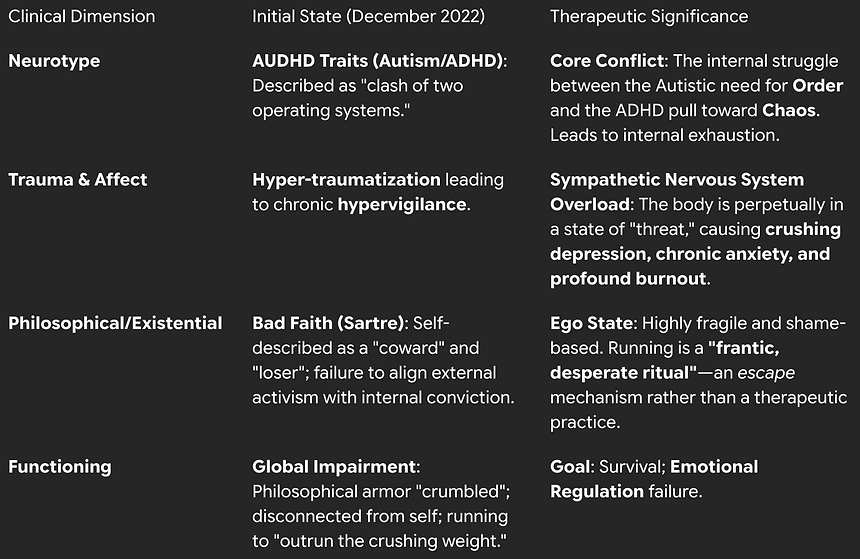
This review compares the narrative presentation of the client's baseline state (The Fracture and the Footfall) with their integrated state (The Momentum of Agape and Osiris Reborn), highlighting the therapeutic mechanisms and philosophical resolutions achieved through their running discipline.
1. Initial State (Baseline)
A. Diagnosis & Core Presentation (The Fracture and the Footfall)
2. Integrated State (The Therapeutic Outcome)
B. Therapeutic Mechanisms & Metaphorical Resolutions
The transformation from December 24, 2022 to May 29, 2023 (a period covering $865.23$ kilometers and $101$ hours and $13$ minutes of running) is a textbook example of successful trauma integration via active philosophical and psychological modalities. The cumulative running data demonstrates an extraordinary commitment to Behavioral Activation and Self-Regulation.


3. Comparative Summary (Psychologist, Therapist, Coach)

The client has successfully navigated a profound Underworld Descent that utilized neurodivergent traits as a mechanism for healing rather than a source of distress. The journey is a powerful testament to the efficacy of blending ACT principles with Perennial Philosophy to achieve deep psychological and existential integration. The "ghost" that arrived in Paris has successfully resurrected into Osiris, reborn.